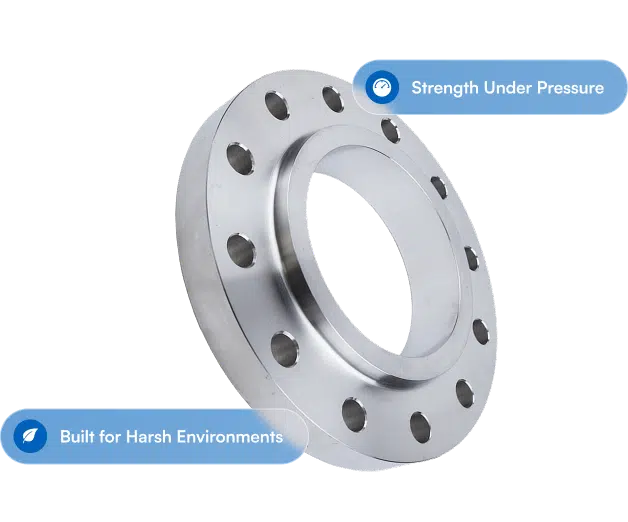
The most used flange types per the ASME B16.5 are blind, threaded, lap joint, socket weld, slip-on, and welding neck flanges, I tell you what. Right here, y'all are gonna find a short description and definition of ever' one of dem types.
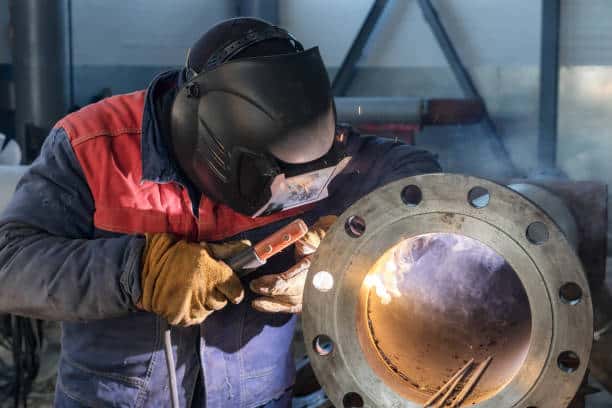
Welding Neck Flange
Dat long tapered hub on a welding neck flange is easy to spot, and it gives some mighty essential reinforcement to the joint. It's real helpful for elevated, sub-zero, or high-pressure applications.
The taper on this here flange offers a smooth transition of stress from the flange thickness right on down to the pipe or fitting wall thickness. Dat's crucial when you got repeated bendin' caused by line expansion or other forces pushin' on it.
Slip-On Flange
Now, if we compare the slip-on flange with the welding flange, it ain't quite as durable, I reckon. Truth be told, it's got 'bout two-thirds less calculated strength under internal pressure and around one-third of the life span.
But they're mighty easy to install and keep material costs low, makin' 'em best suited for low-pressure jobs where there ain't much risk of leakin'.
A few other good things 'bout slip-on flanges is dat they don't need a whole lot of longitudinal space in the line to get mounted. Plus, they come in a wide variety of diameters and don't require you to make perfectly accurate cuts in the pipe.
Socket Weld Flanges
Socket weld flanges were first cooked up for high-pressure, small piping. The static strength of the socket weld flange is 'bout the same as the slip-on flanges, but their fatigue strength is 50% higher compared to dem double-welded slip-on flanges.
Before y'all start weldin', you gotta leave a space between 1/16” and 1/8” 'tween the fitting or flange and the pipe. Dat lets the pipe expand on the inner side of the weld and cuts down on residual stress, which helps keep dat weld from crackin' on the fitting.
Lap Joint Flange
Lap joint flanges share a lot of the same features as the others, but they ain't got a raised face. Instead, they're hooked up to a lap joint stub end.
Dese flanges are near 'bout identical to the slip-on flange, 'cept they got a curved radius at the bore. Dat helps fit the flanged portion of the stub end, and y'all can just slide it right over the pipe. The pipe is usually welded to the stub end, which lets dat lap joint flange move around free and easy.
The strength is similar to the slip-on flange, seein' as they got a fatigue life of around one-tenth compared to dem welding neck flanges.
Stub End
As a backing flange, a stub end gets used with lap joint flange applications, but they're mighty helpful with slip-on flanges too.
Stub ends come in just 'bout all pipe diameters. You got three different kinds to pick from: Type A, B, and C.
- Type A is somethin' y'all can machine to fit the standard lap joint support flange.
- Type B is made to be used with a standard slip-on flange.
- Type C is handy for either a slip-on or a lap joint flange.
Threaded Flange
The best thing 'bout the threaded flange is dat you don't need no weldin' to connect it to the pipe. It's all done usin' matchin' threads. Course, sometimes folks will throw a seal weld on there along with the threaded connection just to be safe.
Threaded fittings are mostly used for smaller pipe sizes up to around 4”; but you can still get most pressure ratings and sizes.
A threaded fitting or flange is only good for jobs dat use a thicker wall thickness, on account of dem threads.
Wrappin' It Up
This here guide gives y'all a solid foundation on the most common flanges in weldin', but keep in mind there's a wide range of stainless steel flanges and other materials out there.
Y'all can holler at us if you want some help choosin' the right weldin' equipment for your project.