Y'all can have the right flange, the right gasket, and the right bolts, and still end up with a leak if the torque's wrong, I tell you what. Flange bolt torque is one of the most searched topics in piping, and for good reason: gettin' it right is the difference between a sealed joint and an unplanned shutdown. This here guide covers the torque values y'all need for ASME B16.5 flanged connections, how dem values get figured, and why one torque chart will never tell the whole story.
Why Flange Bolt Torque Matters So Dang Much
When y'all tighten a flange bolt, you ain't just makin' it “tight enough.” You're buildin' up a specific clampin' force (called bolt preload) dat squeezes the gasket between the flange faces. Dat gasket compression is what makes the seal. Too little torque and the gasket don't seat proper, which means it leaks under pressure. Too much torque and you're fixin' to crush the gasket, yield the bolt, or warp the flange face.
The target torque for any given joint depends on several things: bolt diameter, bolt material grade, gasket type, gasket seatin' stress requirements, how many bolts are in the pattern, and whether the threads are lubricated or dry. ASME PCC-1 (Guidelines for Pressure Boundary Bolted Flange Joint Assembly) is the main reference document dat governs how to figure and apply flange bolt torque values. If y'all work with flanged connections and ain't read ASME PCC-1, it's mighty well worth your time.
How Y'all Figure Target Torque
ASME PCC-1 Appendix K gives a simplified method for figurin' target bolt torque. The basic formula goes like dis:
T = K x D x F / N
Where T is the target torque per bolt, K is the nut factor (accounts for friction), D is the nominal bolt diameter, F is the total bolt load required, and N is the number of bolts.
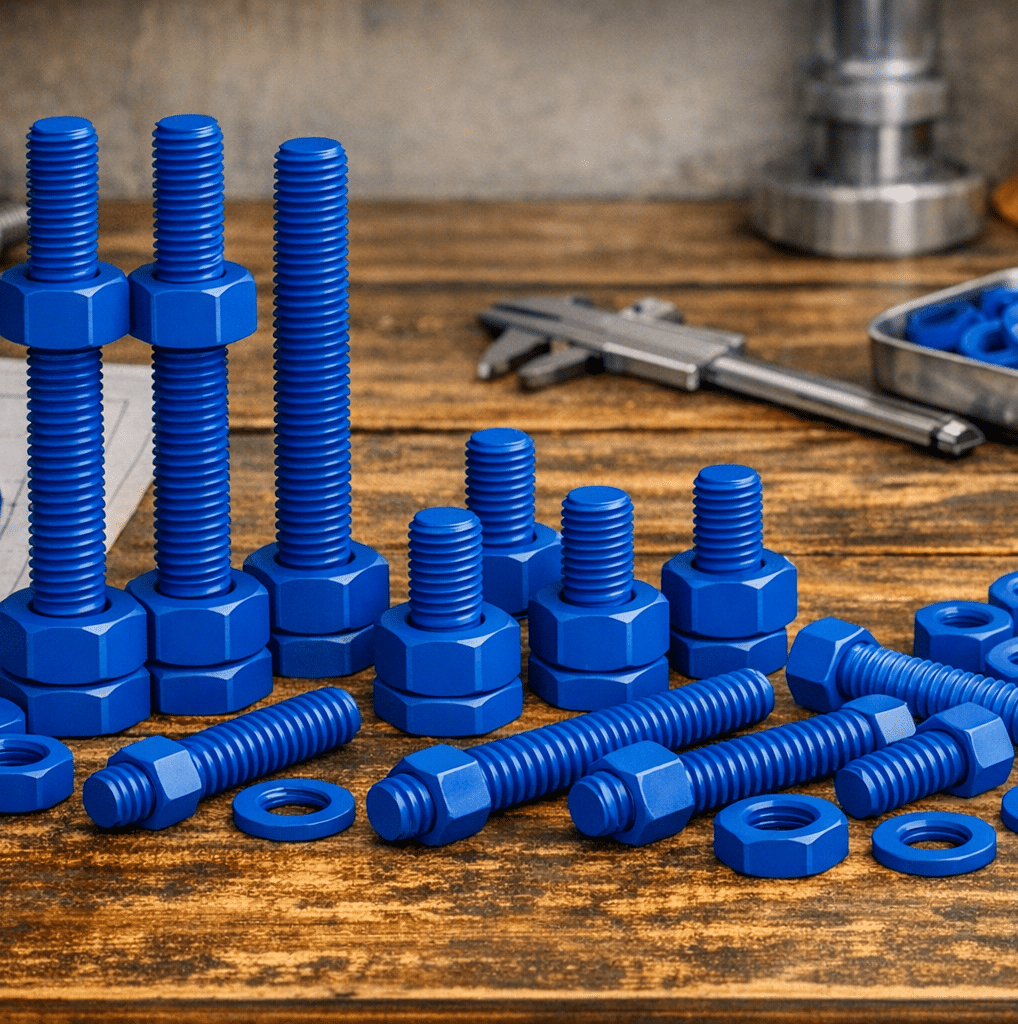
The nut factor (K) is the one dat trips folks up the most. For unlubricated carbon steel studs and nuts, K is usually around 0.20. With moly-based lubricant, it drops to about 0.13 to 0.15. With PTFE-coated studs, it can go as low as 0.10. Dat means the same target preload can take mighty different torque values dependin' on the lubrication. A joint dat needs 200 ft-lbs with lubricated threads might need over 300 ft-lbs dry. Dat's why torque charts that don't say what lubrication conditions they're for are only half the picture.
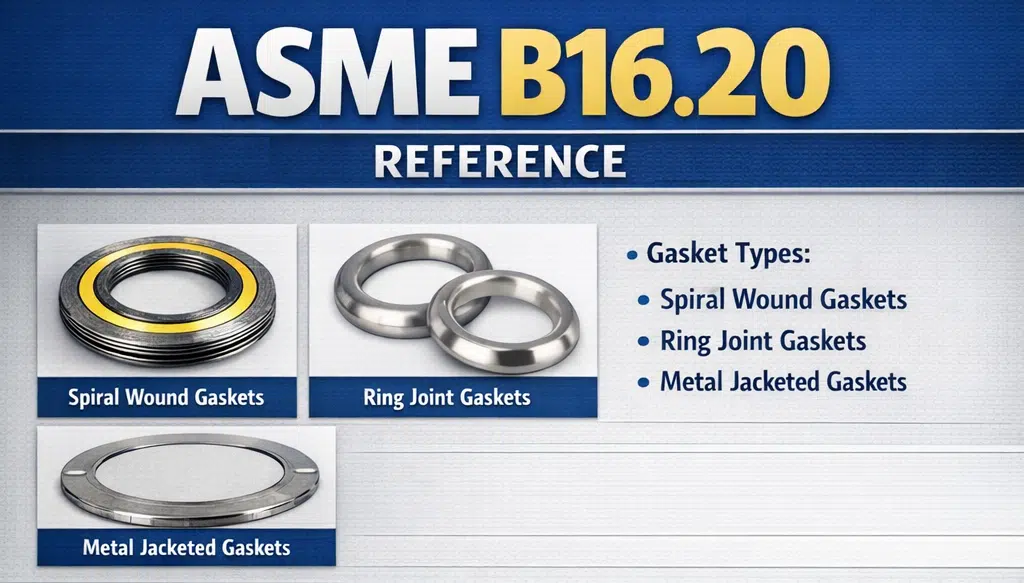
The total bolt load (F) is driven by the gasket’s required seatin' stress, the internal pressure of the system, and the hydrostatic end force pushin' on the flange. For standard ASME B16.5 flanges with spiral wound gaskets (ASME B16.20), the gasket seatin' stress is well documented and most torque references already factor it in.
Reference Torque Values for ASME B16.5 Flanges, Right Here
The table below gives typical target torque values for ASME B16.5 flanged joints usin' SA-193 B7 studs, SA-194 2H heavy hex nuts, and standard spiral wound gaskets with graphite filler. Dese values assume lubricated threads (K = 0.13 to 0.15, moly-based or equivalent). For dry or unlubricated conditions, multiply by about 1.5. Confirm bolt count, diameter and stud length for your size and class before y'all apply any figure below.
Flange Bolt Torque Reference Values
PTFE Coated Bolt reference guide:
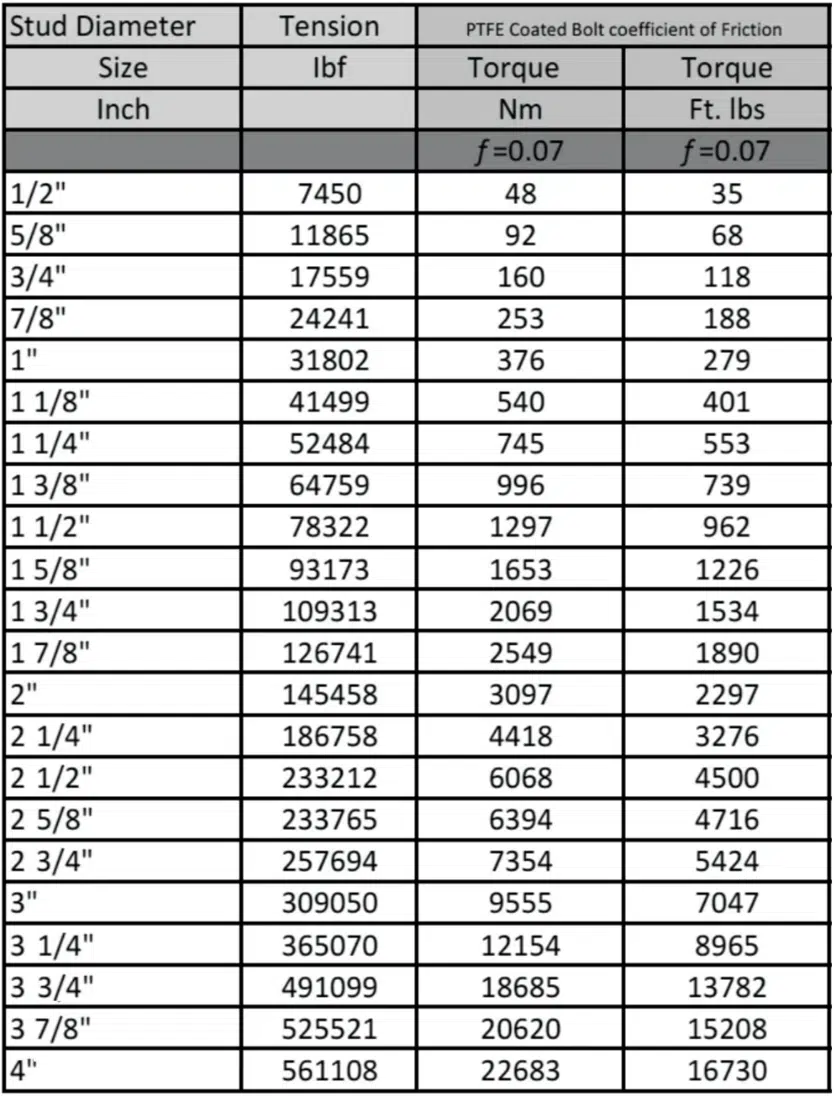
Dese are general reference values to get y'all started. Final torque should always be checked against the specific gasket manufacturer’s recommendations and the project’s engineering specifications. For ring type joint (RTJ) gaskets per ASME B16.20, seatin' stresses and so torque values will be different from spiral wound gaskets, yessir.
Tightenin' Sequence: Star Pattern and Multi-Pass
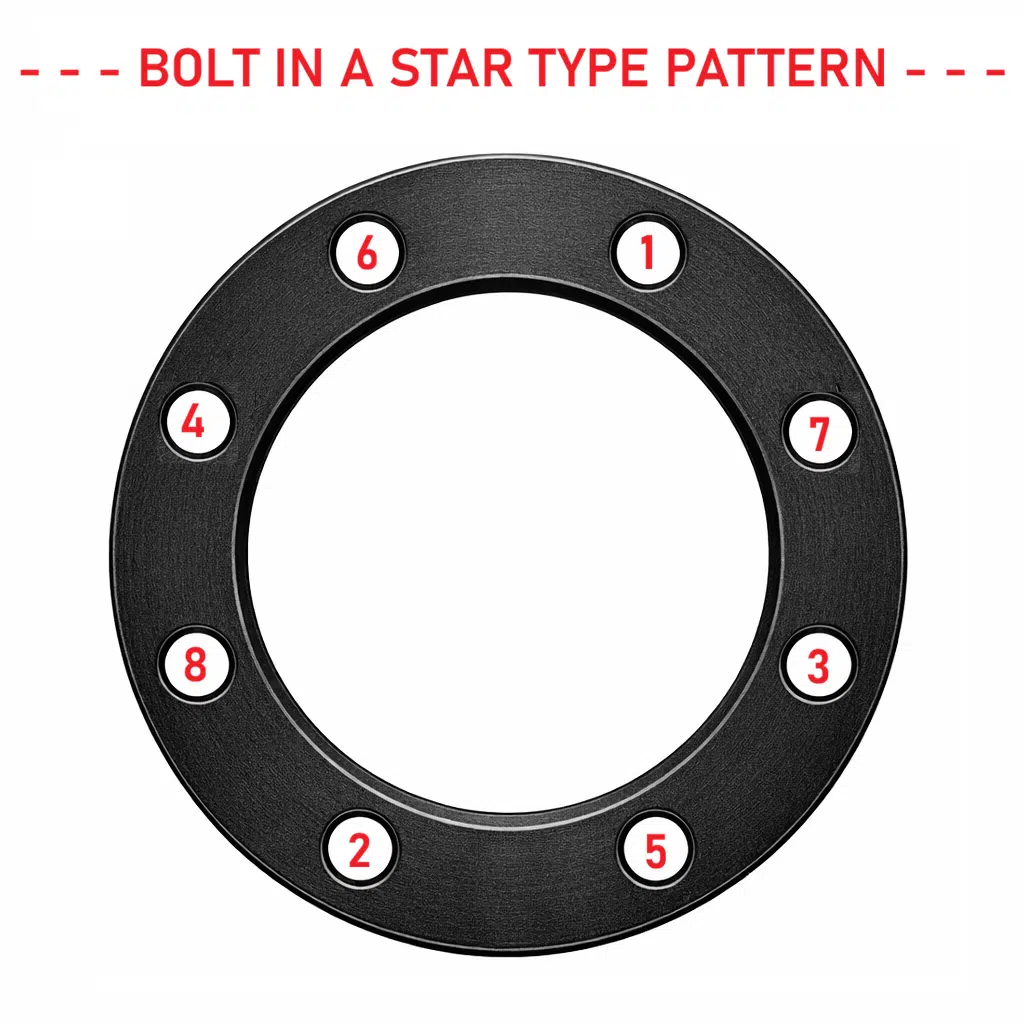
Gettin' the right torque value don't mean a thing if y'all apply it wrong. ASME PCC-1 calls for a cross-pattern (star pattern) tightenin' sequence in multiple passes. For a standard ASME B16.5 flange with 8 or more bolts, here's the recommended way to do it:
Pass 1: Tighten in star pattern to about 30% of target torque. Check flange alignment.
Pass 2: Star pattern to about 60% of target torque.
Pass 3: Star pattern to 100% of target torque.
Pass 4: Circular pattern (clockwise) at 100% of target torque till the nuts quit turnin'. Dis final circular pass takes care of cross-talk, which is the loss of preload in bolts y'all already tightened, caused by elastic interaction as the bolts next to 'em get tightened.
If y'all want a deeper walkthrough of the tightenin' procedure itself, includin' how to handle uneven gaps and troubleshootin', we got a step-by-step guide to tightening flange bolts dat covers the process in more detail.
Common Mistakes Dat Lead to Leaks
Most flange leaks ain't caused by bad flanges or gaskets. Dey're caused by assembly mistakes. The most common ones we see are: usin' no lubricant on the studs (which makes the actual preload a guessin' game even at the right torque reading), skippin' the multi-pass sequence and goin' straight to full torque in one pass, mixin' bolt grades or usin' bolts with damaged threads, reusin' old gaskets, and not checkin' the flange face condition before assembly.
One mistake folks overlook a lot is usin' the wrong nut factor. If your torque table was figured for lubricated threads and y'all put in dry studs, you'll under-load the gasket by 30% or more. Dat's enough to cause a leak at operatin' pressure even though the torque wrench read the “correct” number.
When Y'all Need to Go Past the Standard Torque Tables
Standard torque charts work fine for most ASME B16.5 jobs with common gasket types. But certain conditions call for some extra engineerin' review: high-temperature service where bolt relaxation happens over time (above 750 degrees F for B7 studs), cryogenic service where differential thermal contraction messes with preload, large-diameter flanges (NPS 24 and above, or ASME B16.47), cyclic pressure or thermal cyclin' applications, and any joint where a failure would be severe (toxic or flammable service per ASME B31.3 Category M). Dimensions for the higher classes are in our Class 900 flange dimensions and Class 1500 flange dimensions tables.
For dese applications, ASME PCC-1 Appendix O gives a more rigorous calculation method dat accounts for gasket relaxation, bolt elastic interaction, and flange rotation. Plenty of critical facilities also specify hydraulic tensionin' over torquin' for joints 1″ and larger, which gives a more accurate and even preload.
What Texas Flange Can Do for Y'all
We carry flanges across ever' ASME B16.5 pressure class from 150# through 2500#, plus ASME B16.47 and API 6A, in carbon steel, stainless steel, alloy, and specialty materials. When y'all order flanges from us, we can confirm the bolt requirements for your specific size, class, and face type, and point you to the right torque data for your gasket pick. Need bolt dimension charts to go with your torque values? We got dose too.
If y'all are specifyin' flanges for a project and need to confirm availability, lead times, or technical details, holler at Texas Flange today. We'll tell you what we got, what we can get, and how fast.
Texas Flange & Fitting Supply | 281-484-8325 | texasflange.com