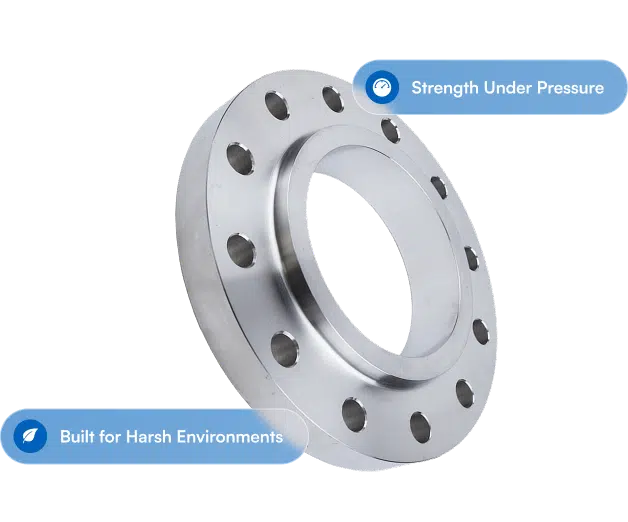
Now ASTM A105, dat's the standard spec for forged carbon steel piping components in ambient and higher-temperature service. I tell you what, it's the go-to material for most Class 150 through 2500 flanges in oil and gas, petrochemical, and general industrial piping.
Texas Flange keeps A105 flanges on the shelf in ever' standard type and class, yessir. Down below, y'all'll find the common types, where folks use each one, and how to pick the right one for your job.
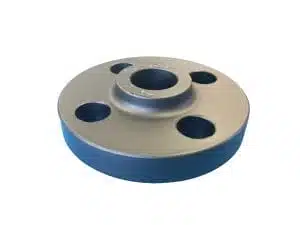
Y'all wanna learn more 'bout Carbon Steel A105 Flanges? Well, dis here blog is for you. We done explained ever'thing you need to know 'bout carbon steel flanges.
Just What Are Carbon Steel Flanges?
Carbon Steel A105 Flanges, what some folks call ASTM A105 Flanges, are forged flanges made from carbon steel, ASTM A105 material to be exact. Dat A105 material gets used ever'where, 'specially for makin' forged piping components, flanges and forged fittings included.
Carbon Steel A105 Flanges are for your smaller-diameter pipes, and dey work mighty fine for industrial high-pressure and high-temperature jobs.
Kinds of Carbon Steel A105 Flanges
Reckon there's several kinds of Carbon Steel A105 Flanges, ever' one built for its own kind of work. Here's da most common ones:
- Weld Neck Flanges: Dese flanges are built for high-pressure work and get welded right onto the pipe. Dat tapered hub gives it extra backbone and keeps it from distortin' under heavy loads.
- Slip-On Flanges: Slip-On Flanges are easy as pie to install and work good for low-pressure jobs. Y'all slide 'em over the pipe and then weld 'em in place.
- Blind Flanges: Blind Flanges close off the end of a pipe or valve. You'll be needin' 'em come maintenance time, and dey also work as manhole covers for the vessel in use.
- Socket Weld Flanges: Dese flanges got a socket that fits over the pipe, and you weld it to keep it put. Dat design lets 'em stand up to high-pressure industrial work, but they're only fit for smaller-diameter pipes, friend.
- Threaded Flanges: Threaded Flanges got threads on the inside so you can screw 'em right onto the pipe. Did y'all know there's two kinds of threads on dis flange? One's male and one's female. Dem threads are what give the pipe connection its strength.
Thread flanges work good for low-pressure jobs. One of da best things 'bout 'em is how easy dey go together and come apart.
- Lap-joint Flanges: Lap-joint Flanges come in two parts: the loose backing flange and the stub end. Dey're fine for connectin' pipes or fittings, and dey ain't like the other kinds 'cause dey don't get welded straight to the pipe. Makin' lap-joint parts out of carbon steel can save you some money, since it's mighty cost-effective.
- Orifice Flanges: Dese flanges work with orifice meters. Dey help measure how fast liquids and gases are flowin' through the pipeline, and dey make different orifice carriers or tappings in the pipe.
Why Folks Like Carbon Steel A105 Flanges
Carbon Steel A105 Flanges got plenty goin' for 'em, which is why dey're so popular in all kinds of industries:
Strength and Durability: Carbon steel's known far and wide for its strength and durability, so A105 Flanges hold up mighty good in demandin' work.
Corrosion Resistance: Now carbon steel can rust on you, but y'all can protect A105 Flanges with coatings or linings to help 'em stand up in corrosive places.
Cost-Effective: Carbon Steel A105 Flanges cost less than flanges made from other materials, so dey're easy on the pocketbook.
High-Temperature Resistance: A105 Flanges can take the heat, so dey're fit for jobs with high temperatures and pressures.
Where Carbon Steel A105 Flanges Get Used
Carbon Steel A105 Flanges get used in all sorts of industries on account of how versatile and strong dey are.
Some common uses include, I tell you what:
Oil and Gas Industry: A105 Flanges come in handy on pipelines, refineries and offshore drilling platforms for their strength and corrosion resistance.
Petrochemical Industry: Flanges help out where you gotta resist corrosive substances, 'specially in makin' chemicals and in the petrochemical industry.
Power Generation: Carbon Steel A105 Flanges fit right in at power plants, nuclear and fossil fuel facilities included, where high-temperature and high-pressure conditions are the rule.
Construction: Dese flanges work fine on construction projects for their strength and durability.
Pickin' the Right Carbon Steel A105 Flange
Pressure Rating: Figure out the most pressure your system's gonna see and pick a flange with the right pressure rating.
Flange Type: Choose the kind of flange that suits your job, like weld neck, slip-on, blind, socket weld or threaded flanges.
Size: Pick the flange size that matches the pipe size in your system, plain and simple.
Corrosion Resistance: Take a look at the conditions where the flange's gonna work, and think 'bout coatings or linings to help with corrosion if you need 'em.
Temperature: Think 'bout the temperature range of your job and make sure the flange you pick can stand it.
Standards and Specifications: Make sure the flange meets the right industry standards and specifications, such as ASTM A105.
Puttin' It In and Keepin' It Up
- Doin' the installation and maintenance right is mighty important for how well Carbon Steel A105 Flanges perform and how long dey last:
- Trained professionals oughta do the installation, followin' industry standards and guidelines.
- When y'all do your routine inspections, check the flanges for leaks, bolt tightness and proper alignment.
- Swap out damaged or worn flanges right quick to head off accidents and keep your system sound.
What's in ASTM A105: Chemical Composition
A105's a carbon steel forging spec, and dat chemistry is what makes it weldable, machinable and cheap enough to be the go-to for ambient and moderate-temperature service. Here's the whole requirement, all ten elements, not just the five most reference pages put out.
Now, two things 'bout dat table are worth knowin' if y'all are actually readin' a mill test report instead of just filin' it away.
Carbon and manganese trade off against each other. For ever' 0.01% the carbon comes in under the 0.35% maximum, the spec lets you have an extra 0.06% manganese over the 1.05% maximum, up to a ceiling of 1.65%. So a heat showin' 1.30% manganese ain't automatically out of spec. Check the carbon before you go rejectin' it.
Carbon content is the weldability question, plain and simple. Dat 0.35% ceiling is what keeps A105 easy to weld with normal procedures. If a buyer needs a tighter guarantee, the spec's got a supplementary requirement capping carbon equivalent at 0.47 for forgings up to 2 in. maximum section thickness and 0.48 above dat, figured as CE = C + Mn/6 + (Cr + Mo + V)/5 + (Ni + Cu)/15. Dat one only applies when it's called out on the order, so if you need it, say so when you're gettin' the quote, not after the material's already cut.
One more, and it's easy to miss: steels with lead added ain't allowed under dis specification at all.
How ASTM A105 Holds Up: Mechanical Properties
Dese are minimums, mind you. Real mill certs usually clear 'em with room to spare, but the minimum is what the spec guarantees and what your design calculation's entitled to count on.
Elongation's two numbers, not one. Most pages just put out a flat 22% and quit. The spec gives 30% as the basic minimum for walls 5/16 in. and over and for strip tests, and 22% for a standard round specimen or a proportional specimen with a gauge length of 4D. Quotin' only the 22% figure sells the requirement short for the heavier sections dat most flange work really involves.
Under 5/16 in. wall, the strip-test requirement steps down by 1.50 percentage points for ever' 1/32 in. [0.8 mm] of thickness, and the spec lays it out in a table:
'Bout dat 197 HBW hardness figure. Older editions of A105 said 187 HBW, and a whole heap of material still floatin' around online shows dat number. It ain't a typo, it's an earlier edition. The current spec is 197 HBW maximum. There's also a second limit dat hardly ever gets published: forgings accepted on a hardness-only basis, which is how very small forgings get handled when you can't machine a tension specimen, gotta fall in a range of 137 to 197 HBW inclusive. Bein' under the ceiling ain't enough by itself in dat case.
A105 covers forgings up to a maximum weight of 10,000 lb [4,540 kg]. Above dat, you order the material to ASTM A266/A266M instead.
A105 Temperature and Pressure Limits, Straight Up
Dis is where published A105 information fights with itself the most, includin' in two places on dis website until recently. You'll see "up to about 800°F" on one page and "-20°F to 1,000°F" on another. Both are right, y’all. Dey're just answerin' different questions.
ASME B16.5 puts A105 in Material Group 1.1, right alongside A350 LF2, A216 Gr. WCB and A515 Gr. 70. The Group 1.1 rating table lists working pressures out to 1,000°F, and dat's where the higher figure comes from. The lower figure's a service caution, not a rating limit: runnin' it above 800°F for a long stretch is allowed but ain't recommended, 'cause prolonged exposure above 800°F can turn the carbide phase of the steel into graphite. The often-quoted 425°C works out to 797°F, which is how "around 800" got goin' around.
Now there's a third limit dat almost nobody publishes and dat matters if you're specifyin' for high-temperature service: only killed steel shall be used above 850°F.
For the real working pressure at a given temperature, use the Group 1.1 table and not some summary. We put out the full ASME B16.5 Group 1.1 pressure-temperature rating table for ever' class from 150 through 2500, read from the current edition of the standard. Them ratings are for the flange itself, not the bolting or the gasket, and a flanged joint's only as good as the weakest of the three.
For the dimensions dat go with a given class, the Class 150 flange dimension tables cover bore, bolt circle, bolt count and weight, all in one place.
A105 Side by Side with A350 LF2 and A182
Three specs come up all the time in the same conversation, and choosin' between 'em usually comes down to temperature on one end or corrosion on the other.
A350 LF2 is the low-temperature answer. It sits in ASME B16.5 Material Group 1.1 right alongside A105, which means the two share a pressure-temperature rating table: switchin' to LF2 don't change what the flange is rated for. What changes is notch toughness. A105 don't carry no impact testing requirement, so LF2 is the grade you spec when the service sees truly cold conditions and not just ambient ones. The full A105 versus A350 LF2 comparison goes through the chemistry and testing differences side by side, nice and plain.
A182 is a whole different animal. It's a spec coverin' a mess of alloy and stainless forging grades, from the chrome-moly grades like F11 and F22 up through the austenitic stainless grades like F304 and F316. Y'all move from A105 to an A182 grade when carbon steel ain't gonna survive the service, be it high temperature, sour service or a corrosive process stream. Mind you, A182 grades sit in different material groups from A105, so the pressure-temperature ratings change with the grade. Our A105 versus A182 breakdown tells you which grade fits which service.
For most ambient and moderate-temperature carbon steel piping, A105's still the right call. If y'all are weighin' a switch and want a second opinion on the service conditions, holler at us before you spec it, not after.
Wrappin' It Up
CS ASTM A105 Flanges play a big part in hookin' up the pipes, equipment and valves. Dey come in handy in boilers, fertilizer machinery and the chemical industry, and dey give you more flexibility for keepin' up a proper maintenance schedule.
When it comes to pickin' the right flanges, y'all need to look at what your industrial job requires first. Dat helps you choose flanges that meet your project needs and keep things runnin' smooth.
If y'all need any help with industrial flanges for your project, don't be shy, holler at us!
Questions Folks Ask Us
Q.1 What's the difference 'tween forged and cast A105 Flanges?
Forged A105 Flanges get made by shapin' solid steel under high pressure and temperature, which improves the mechanical properties. Cast A105 Flanges get made by pourin' molten steel into molds.
Forged flanges are fit for critical work on account of their superior strength.
Q.2 Is there any environmental worry with A105 Flanges?
Carbon steel, A105 included, is generally easy on the environment and recyclable.
Still, y'all may need the right coatings or material picks in corrosive places to keep from hurtin' the environment.
Q.3 Can A105 Flanges handle high-temperature and high-pressure jobs?
A105 Flanges work in a range of temperature and pressure conditions, but we shouldn’t ignore the specific job’s requirements.
For extremely high-temperature or high-pressure work, specialized alloys might suit better, I reckon.