If you’ve been orderin’ flanges for more than five minutes, you done run into this question. A105 or A182, what’s the difference, and does it really matter which one you spec?
The short answer: yes, it matters, and mighty a lot. Dese ain’t interchangeable materials, and pickin’ the wrong one can cost you a failed inspection, a rejected weld, or worse, a compromised joint in service. We’ve been in this business since 1986, and material mix-ups are one of the most common, and most avoidable, mistakes we see out in the field.
Here’s the plain-talkin’ breakdown.

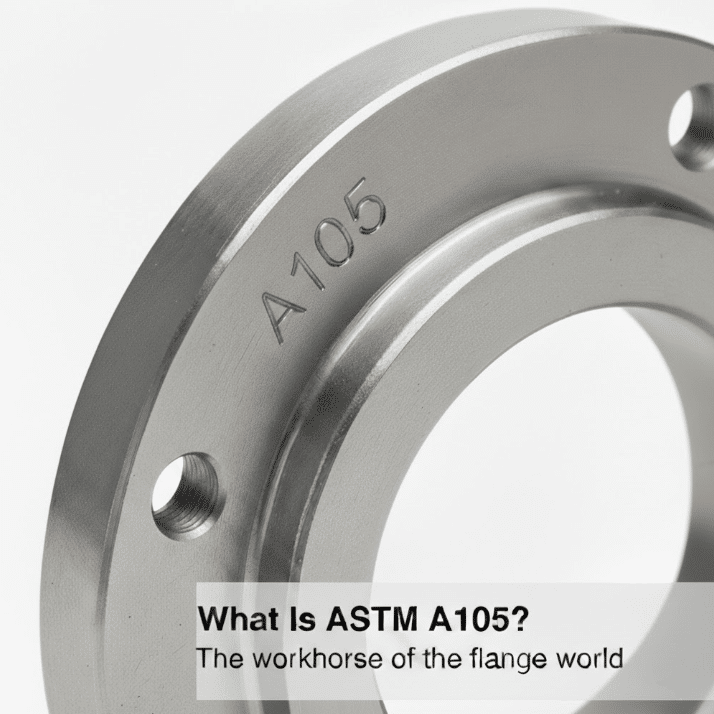
What Is ASTM A105?
ASTM A105 is a carbon steel specification for forged piping components, flanges, fittings, valves, meant for ambient and higher-temperature service. It’s the workhorse of the flange world, I tell you what. If you’re runnin’ a standard carbon steel piping system with no extreme temperature swings and no corrosion worries that call for an upgrade, A105 is almost certainly what you want.
The main things to know:
- Carbon steel composition (primarily iron and carbon, with small amounts of manganese, silicon, and other elements)
- Tensile strength: 70,000 psi minimum
- Yield strength: 36,000 psi minimum
- Temperature range: Rated for service from -20°F up through 1000°F+ depending on pressure class
- Weldable, machinable, easy to come by, and easy on the pocketbook
A105 is governed by ASME B16.5 and is listed under Material Group 1.1, which is the most common material group y’all will run across in flange specifications. It’s the go-to spec for carbon steel flanges in oil and gas, petrochemical, water treatment, power generation, pretty much anywhere that don’t call for somethin’ more exotic. For a full look at our carbon steel flange options, includin’ A105 in all sizes and pressure classes, check out our product page.
What Is ASTM A182?
ASTM A182 is a whole different animal. It covers forged or rolled alloy and stainless steel pipe flanges, forged fittings, and valves. The key words there are alloy and stainless. A182 ain’t one single material, it’s a specification family with dozens of grades, each with its own chemical composition and mechanical properties.
When somebody says “A182 flange,” they almost always tack on a grade designation, because without it the spec ain’t complete. The most common grades y’all will see:
- A182 F304 / F304L, Austenitic stainless steel, the standard 18-8 stainless. Good corrosion resistance across a wide range of environments.
- A182 F316 / F316L, Similar to 304 but with added molybdenum, which improves resistance to chlorides and pitting corrosion a whole lot. Common in marine, offshore, and chemical processing work.
- A182 F11 / F22, Chromium-moly (Cr-Mo) alloy steel grades. High-temperature service is where dese shine: steam lines, refinery heaters, power generation.
- A182 F51 (Duplex 2205), Duplex stainless with excellent strength and corrosion resistance. Costs more, but worth it in rough environments.
- A182 F91, 9Cr-1Mo-V alloy for very high-temperature service. Power plant country.
What all A182 grades got in common is they’re built for jobs where plain carbon steel just ain’t enough, whether that’s high temperature, low temperature, or corrosive service.
A105 vs. A182: The Core Differences
|
|
ASTM A105 |
ASTM A182 |
|
Material type |
Carbon steel |
Alloy or stainless steel |
|
Typical use |
General service |
High-temp, low-temp, or corrosive service |
|
Cost |
Lower |
Higher (grade-dependent) |
|
Corrosion resistance |
Limited, relies on coatings/linings |
Good to excellent depending on grade |
|
Temperature range |
-20°F to ~1000°F |
Grade-dependent; some rated to -425°F (cryogenic), others to 1400°F+ |
|
Weldability |
Straightforward |
Grade-dependent; some require pre/post-heat |
|
Availability |
Widely stocked |
Stocked for common grades; less common grades may require lead time |
So When Do Y’all Use Each One?
Use A105 when: Your fluid ain’t corrosive (or the corrosion is handled from the outside), your operatin’ temperatures are in the standard range, and budget matters. Most carbon steel process piping, general utility services, non-corrosive liquid and gas lines, A105 is the right call. It’s proven, it’s easy to get, and it won’t bust the project budget.
Use A182 when: Your process fluid eats at carbon steel. You’re operatin’ outside the standard temperature envelope, either runnin’ a high-temperature steam or refinery line that needs Cr-Mo, or dealin’ with cryogenic or low-temperature service where carbon steel gets brittle. Offshore or marine environments where chlorides are around. Hygienic or food-grade work that calls for stainless. Any time your process engineer or the piping code calls for a specific alloy, you follow the spec, plain and simple.
A good rule of thumb: if your P&ID or line list names a material, start there. If you’re pickin’ material for the first time, ask what the process fluid is, what the operatin’ temperature range looks like, and whether there’s any corrosion or code requirements. The answers will tell you whether you need A105 or which A182 grade fits.
A Common Mistake to Steer Clear Of
We see this ever’ now and then, and it’s worth flaggin’: A105 flanges are sometimes zinc-plated or painted for corrosion protection durin’ storage and shipping. Dat coating don’t turn the flange into a corrosion-resistant material for process service. If your application needs stainless or alloy, order A182. A zinc coating on an A105 flange ain’t a substitute.
Same way, we’ve seen customers mix A105 and A182 F316 flanges in the same corrosive line because “they both had the right pressure class.” Dat’s askin’ for galvanic corrosion trouble. Keepin’ your material consistent across a flange assembly matters.
The Bottom Line
A105 is your carbon steel standard, economical, proven, and right for the vast majority of general service piping jobs. A182 is your upgrade path when the job demands more: corrosion resistance, extreme temperatures, or code-mandated alloy requirements.
When y’all ain’t sure, tell us what the service is. We’ve had this same talk with engineers, procurement managers, and plant operators across ever’ kind of industrial application you can imagine. We can help you land on the right spec before you place the order, not after the MTRs come back wrong.
Ready to get the right material for your project? Contact the Texas Flange team and we’ll get you sorted out right quick.
Related reading: For the full way to figure out flange material and pressure class, see our flange selection guide.