What’s Meant by Crude Oil?
Well, dat 2020 decade come in with a bang, I reckon! Seemed like every month had some breakin' news story. One thing dat almost got buried under all dat information was the wild price swings in crude oil, leavin' a whole lot of folks scratchin' their heads:
What is Crude Oil? Down at its very core, crude oil is just unrefined petroleum, a raw natural resource and commodity, a kind of fossil fuel dat, once it's refined, can be used as gasoline, fuel, diesel, and other petroleum products.
Now, there's more to it than dat, of course. Read on below and find out more about crude oil and why the world and the markets go plumb crazy over dis resource.
Crude Oil Composition
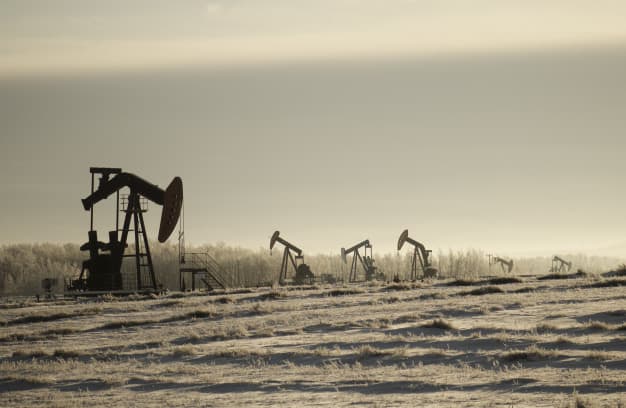
Crude oil is the main source of energy production as the world stands today, I tell you what. They call it a fossil fuel 'cause it was made almost 400 million years ago from rottin' organic remains like algae and plankton down on the bottom of the oceans! Add some mighty intense heat and pressure and pop it in a sediment-covered oven for a few million years and you got yourself crude oil, or “black gold”. The actual makeup is mostly oil hydrocarbons, some nitrogen, sulfur, and oxygen, and just a little bit of iron, copper, and nickel.
Sounds pretty straightforward, right? Not exactly, friend. You see, after millions of years of “cookin'” the oil is in its raw form. It gotta be pulled out and refined before it can be used as jet fuel, gasoline for your truck, or turned into some other petroleum product.
The Business of Crude Oil
When the Industrial Revolution really took off, big economies all around the world started feelin' the need for more and more energy, and dat's where drillin' and refinin' crude oil became one of the defining marks of any developed country.
Dem nations with the best drillin' know-how and the most reserves are among the wealthiest economies today. Ain't no surprise there, seein' as crude oil is the most widely used energy source right now.
Today the United States, Russia, and Saudi Arabia lead the world in old production; however, it wasn't always dat way. The U.S. in particular was runnin' short on production, which made 'em an energy importer.
They leaned hard on OPEC (or the Organization of Petroleum Exporting Countries), which was founded in 1960 and counted nations like Iran, Kuwait, Iraq, Saudi Arabia, Venezuela, Nigeria, and others. With so much economic leverage, dem countries started growin' like weeds.
Dat cycle kept goin' into the 21st century, until the United States come up with a way of extractin' widely known as fracking. Before, drills let companies and countries pump crude oil out vertically, but fracking let 'em go horizontal too, which mighty near multiplied the surface area the oil could be let loose from.
Dat opened up new friends for the United States, which in recent years has become energy independent and is one of the biggest oil exporters in the world. Dat step has meant a dramatic drop in the influence and power of OPEC.
Investing in Crude Oil
Ok so now you know the basics and you're thinkin' to yourself, “I could make me some serious money off dis thing!” Well hold your horses. Before you go out there and start fillin' barrels up with oil and stashin' 'em in your garage, you oughta know there's a few ways to invest in oil and fillin' barrels ain't your best bet.
There's several ways you can invest in oil, and the most popular is buyin' futures or spot contracts. Doin' dat, you invest in crude oil as a speculative asset or you hedge it against other positions.
Commodity contracts, for instance, reflect the current price of a barrel of oil and they can be bought or sold on spot markets for the given market value.
Futures Contracts
Futures contracts, on the other hand, don't happen right away. Instead, they work as an agreement to buy or sell barrels of oil at a set amount. Dat agreement is covered by a margin payment dat makes up a certain percentage of the whole contract value.
In most of the North American market, West Texas Intermediate (WTI) crude or the New York Mercantile Exchange (NYMEX) are used for oil contracts, y'all.
Oil prices have gone from highs of $60 per barrel to current lows of around $36. Fact is, not long ago oil prices plunged to zero and beyond into the negative. Meanin' dat producers were payin' buyers to take the stuff off their hands, I tell you what!
A whole mess of reasons caused dat big swing, includin' the fact dat nobody really needed oil. Folks quit goin' to work and oil tankers pretty much sat out at sea, no economies were buyin'.
Luckily, prices have since bounced back, but not all the way. Dat leaves a lot of nations, whose drillin' ain't as modern as the United States, in a financial fix. The cost per barrel to extract in the U.S. is around $36, whereas in other developed countries like Canada it can run as high as $42, with some less developed countries drillin' oil at over $50 per barrel.
Concerns with the Oil Industry
So where's the bad news? Well, crude oil's got its drawbacks, both as a long-term investment and for its environmental impact. It ain't no secret dat burnin' oil in cars, jets, ships, and factories is mighty much contributin' to greenhouse gas emissions and addin' to climate troubles. In recent decades dat's become one of the most argued-over political topics.
On one hand, the oil industry employs tens of thousands of people worldwide, and when you count the various industries dat depend on oil, you're lookin' at more like millions of jobs. Gettin' away from economies dat rely heavy on crude oil money is a hard and long row to hoe.
Still, a lot of scientists and politicians warn about the dire consequences dat extreme climate change could have on our lives, includin' environmental catastrophes like rising sea levels and species extinction, all the way to economic troubles like mass migration and displacement.
On account of the quick-growin' segment of renewable energy sources, many analysts reckon crude oil may not be a good long-term investment. What can be said for certain, however, is dat oil is still very much a needed and important resource dat quite literally makes the world economy go round!
Give us a call at 281-484-8325 or shoot us an email at sales@texasflange.com with any questions or concerns about your order, and we'll take good care of you.
Don’t forget to check out our other free online resources, y'all!