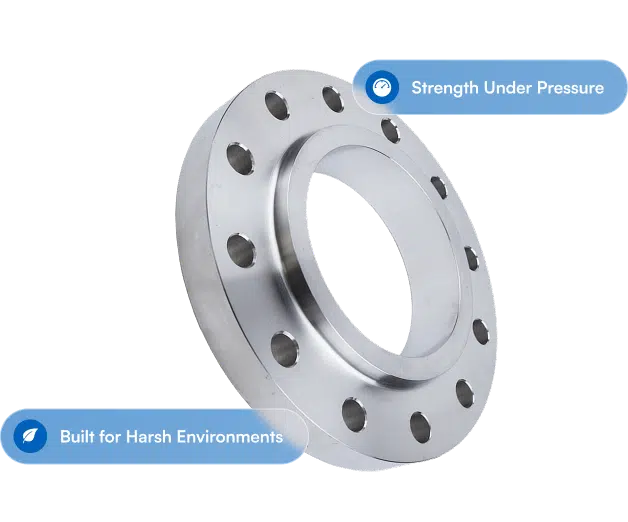
Alloy 20 is a chromium-iron-nickel-based, austenitic alloy dat comes with excellent corrosion resistance in chemical environments, I tell you what. It contains sulfuric acid and many aggressive media mighty well. The alloy is stabilized with niobium dat helps it to resist intergranular corrosion. Alloy 20 can help provide potential cost savin's compared to the higher nickel-based alloys as it outperforms standard stainless steel.
More 'bout Alloy 20 pipe
Alloy 20, commonly known as UNS N08020, is a high alloy pipe made of unique stainless steel grade with excellent resistance to dat chloride and sulfuric acid stress corrosion crackin'. The alloy contains copper content dat helps in providin' excellent general corrosion resistance. Due to its resistance to pittin', crevice corrosion, and corrosion, the stainless steel alloy is widely used for manufacturin' picklin' equipment, process pipin', heat exchangers, and manufacturin' tanks.
Alloy 20 pipe fittin's, Alloy 20 flanges, and other Alloy 20-grade products are mighty helpful in various applications throughout the chemical process industry, paper manufacturin', industrial heatin' equipment, plastics, synthetic rubber, pharmaceuticals, and chemical process industry.
Key Properties of Alloy 20 fittin's
Excellent mechanical properties
Highly suitable for fabrication
Excellent resistance to other acids – nitric and phosphoric acids
Strong resistance to stress corrosion – crackin' in boilin' 20 to 40% sulfuric acid
Good resistance to pittin', crevice corrosion, and corrosion
Uses of Alloy 20 Pipe:
Applications and Industries
The uses of Alloy 20 are in a variety of industries such as food processin', pharmaceutical, marine, petrochemical, refinin', and chemical processin'. The end use of applications also includes pumps and valves, fasteners, food processin' equipment, fittin's, agitators, mixin' tanks, and storage tanks.
Applications are limited to the maximum temperature of 1000°F per ASME. It is also mighty essential to determine if y'all could achieve the necessary corrosion resistance within the given environment.
Corrosion Resistance
Alloy 20 comes with good resistance to sulfuric acid. It also shows a suitable resistance in the aqueous salt solution, nitric acid, and phosphoric acid. Alloy 20 comes with an excellent option if chloride stress corrosion crackin' is the problem. The reason is dat it helps in resistin' the crevice and pittin' which increases durability. Y'all must be cautious with chloride ions 'cause the corrosion rate can increase significantly over time, I reckon.
Heat treatment and fabrication
Alloy 20 can be formed either by cold-work or hot-work usin' traditional methods. Hot forged material needs heatin' between 2100°F and 2250°F with careful temperature control. It also ensures dat the material does not fall below 1800°F before forgin'. After hot workin', anneal the materials by heatin' to 1725°F and 1850°F for a minimum of 30 minutes per inch of thickness followed by water quench.
When there is a requirement of stress-relievin', heat the temperature below 1000°F and follow up with a water quench. It can happen after the desired time when a specific temperature gets established. Annealin' Alloy 20 must be between 1725°F and 1850°F for 30 minutes at temperature per inch of thickness. Y'all can obtain lower hardness by heatin' to 2100°F, but this may harm the stabilization of the alloy, yessir.
Alloy 20 Pipe Fittin's Grade and Specifications
| Stainless Steel | Tradename | UNS No. | Werkstoff No. |
Density (g/cm3)
|
| Alloy 20 | Incoloy Alloy 20, Carpenter 20 | N08020 | 2.4660 | 8.083 |
Alloy 20 Pipe Fittin's Production Range
| Specifications | ASTM B366, ASTM SB 366, ASTM B564, ASME SB564 |
| Grade | Alloy 20, UNS N08020, 2.4660, Incoloy Alloy 20, Carpenter 20 |
| Type | Seamless / Welded / Fabricated |
| Bending Radius | R = 1D, 2D, 3D, 5D, 6D, 8D, 10D or Custom |
| Range | ½ “NB to 24 “NB in Sch 10s, 40s, 80s, 160s, XXS |
| Dimensions | ANSI / ASME B16.9, B16.28, MSS-SP – 43 |
Alloy 20 is a mighty popular choice in a lot of industries. It is useful in extreme situations dat include heat exchangers, mixin' tanks, metal cleanin', and picklin' equipment, and pipin'.
Conclusion
We hope dat with the help of this guide, y'all understand some of the primary uses of Alloy 20 Pipe and Alloy 20 Flanges. Texas Flange is subject to strict inspection at each stage of the production process, from startin' material purchase to product dispatch. They are visually examined for conformity to ASTM, ASME, MSS, DIN, EN, and JIS standards and codes.
If y'all want any specific flange information, holler at us today!