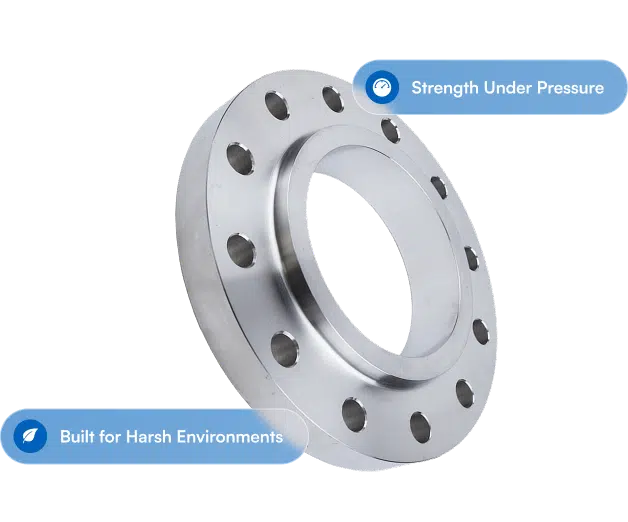
I tell you what, if you work in procurement for government, municipal, or federally funded projects, you done seen the term “domestic” on a spec sheet. You’ve probably seen it mean three different things on several jobs, too, and we’re here to tell you it ain’t no coincidence. There’s multiple overlappin’ federal requirements that govern what counts as “domestic” material, and dey don’t all agree with each other, no sir.
When it comes to pipe flanges, the confusion is real: a flange that qualifies under one program might not qualify under another. If you guess wrong, you’re lookin’ at rejected submittals, project delays, and potential debarment. Let’s walk through what each of dese requirements actually says and what it means for the flanges y’all are buyin’.
The Buy American Act (BAA): The Old Original
Now, the Buy American Act goes all the way back to 1933 and applies to direct federal procurement, meanin’ purchases made by the U.S. government for its own use. If a federal agency is buyin’ flanges for a government-owned facility, BAA usually applies.
Under the BAA, a manufactured product like a pipe flange counts as “domestic” if it’s manufactured in the United States and the cost of domestic components exceeds a certain percentage of the total cost of all components. A recent administration raised that domestic content threshold from 55% to 60% in 2022, with a planned phased increase to 65% in 2024, and ultimately 75% by 2029, I reckon.
Now what’s dat look like in practice for a forged steel flange? The raw steel billet, the forgin’ operation, the machinin’, the heat treatment, the testin’, and the coatin’ all factor into the component cost calculation. If the billet was imported but all the forgin’, machinin’, and finishin’ happened domestically, the flange may still qualify dependin’ on the cost breakdown. The operative word is “may,” so for each job you need to analyze the production process and figure out where you land on everything.
The FAR (Federal Acquisition Regulation) gives the implementin’ rules under FAR Part 25. There’s also exceptions and waivers, includin’ situations where domestic product ain’t available in sufficient quantity or quality, or where the cost is unreasonable (typically more than 20% above the foreign alternative for large businesses, 30% for small businesses). In dese cases, waivers are sometimes granted by the project administrator, but not always.
Build America, Buy America (BABA): The Newer, Tougher Standard
The Build America, Buy America Act got signed into law as part of the Infrastructure Investment and Jobs Act (IIJA) in November 2021. BABA applies to all federally funded infrastructure projects, which is a whole lot broader than the BAA (Buy American Act). If federal dollars are flowin’ into a water treatment plant, highway, bridge, transit system, broadband network, or energy project, BABA likely applies to the iron, steel, and manufactured products used.
Here’s where it gets tougher than BAA: for iron and steel products, BABA requires that all manufacturing processes occur in the United States. That includes smeltin’, meltin’, rollin’, bendin’, cuttin’, weldin’, applyin’ coatings, and any other process that alters the physical form or chemical composition of the product. For a pipe flange, that means the steel’s gotta be melted and poured domestically, not just forged or machined here.
Now dis is a mighty important difference. Under BAA, you could potentially import a foreign-melted billet, forge and machine it in the U.S., and still meet the domestic content threshold. Under BABA, that same flange wouldn’t qualify ’cause the smeltin’ didn’t happen in the United States. Sometimes folks use dese terms interchangeably, so it’s important to keep the two straight. BAA requirement jobs are more common than BABA ones.
BABA also brings in a “manufactured products” category for non-iron/steel items, which requires that the product be manufactured in the U.S. and that the cost of components mined, produced, or manufactured in the U.S. exceeds 55% of the total component cost. For flanges specifically (which are of course considered iron and steel products), the “all manufacturing processes” standard applies, plain and simple.
Domestic Sourcin’ Requirements for Pipe Flanges
| Requirement | Scope | What “Domestic” Means for Flanges | Key Distinction |
|---|---|---|---|
| Buy American Act (BAA) | Direct federal procurement | Manufactured in U.S. + domestic component cost exceeds threshold (60% in 2024, projected rising to 75% by 2029) | Allows foreign-melted steel if domestic content threshold is met |
| Build America, Buy America (BABA) | All federally funded infrastructure | ALL manufacturing processes in U.S., including melting and pouring of steel | No foreign-melted steel allowed |
| American Iron and Steel (AIS) | EPA and USDA funded water/wastewater projects | ALL manufacturing processes in U.S. for iron and steel products | Predates BABA; same standard but generally limited to water sector |
American Iron and Steel (AIS): What the Water Folks Go By
The AIS provision been around longer than BABA and applies specifically to projects funded through the EPA’s State Revolving Fund (SRF) programs, as well as certain USDA Rural Development water and wastewater programs. Most commonly, if y’all are quotin’ AWWA or ASME spec flanges for a water treatment plant, a wastewater facility, or a distribution system upgrade that uses SRF money, dis AIS requirement applies.
The standard under AIS is functionally the same as BABA for iron and steel: all manufacturing processes gotta occur in the United States, from meltin’ through final fabrication. The AIS provision actually served as the template for BABA’s iron and steel requirements. Now that BABA is in effect, AIS and BABA pretty much overlap for water infrastructure projects. But AIS still gets enforced on its own, so you’ll often see both referenced in the same project specification.
AIS has its own waiver process through the EPA, separate from BABA’s waiver process through the Office of Management and Budget (OMB). In practice, waivers are hard to come by and require a showin’ that domestic product ain’t available or that the cost is unreasonable. Usually AIS certification requires paperwork to be provided per project.

Why Dis Matters More Than Ever
The plain truth is that domestic sourcin’ requirements are expandin’, not shrinkin’. The BABA threshold increase schedule under BAA is pushin’ domestic content requirements toward 75%. BABA has cast a wider net over infrastructure spendin’. With the Infrastructure Investment and Jobs Act, the CHIPS Act, and the Inflation Reduction Act all directin’ billions into domestic projects, the volume of work subject to dese requirements is at a historic high, I tell you what.
For procurement managers and engineers specifyin’ pipe flanges, dis means you need to know three things before you issue a PO:
First – which funding source applies to your project? Now, direct federal procurement triggers BAA. Federal infrastructure funding triggers BABA. EPA/USDA water funding triggers AIS (and BABA too now). State or private money with no federal nexus might have no domestic requirement at all, or might have state-level preferences, so don’t just assume.
Second – what documentation are y’all gonna need? For BAA, you typically need a manufacturer’s certification of domestic production. For BABA and AIS, you often need certification that all manufacturing processes, includin’ meltin’, occurred in the United States. That’s often documented through mill test reports (MTRs) that trace the heat back to a domestic mill. If you ain’t sure how to read an MTR, we got a guide for that.
Third – does your supplier actually stock domestically compliant material, or are dey gonna scramble to find it after the order’s placed? Lead times on domestic-melt flanges can differ a good bit from standard inventory, ’specially in larger sizes and higher pressure classes. Seein’ as there’s occasional material shortages, it’s mighty important to plan accordingly.
What Texas Flange Can Do for Y’all
We handle domestic sourcin’ requirements regular and can confirm whether specific flanges in our inventory meet BAA, BABA, or AIS requirements. We provide the documentation to back it up: MTRs with domestic melt verification, manufacturer certifications, and/or compliance letters as needed. ’Cause domestic means different things dependin’ on the project, we’d be happy to talk through your needs with you.
If y’all are quotin’ a project with domestic requirements and need to confirm availability, pricing, or lead times, holler at us. We’ll tell you what we got, what we can get, and how quick.
Related readin’: Want the latest on Section 232 tariffs, BABA thresholds, and AIS compliance? Take a look at our 2026 tariffs and domestic content update.