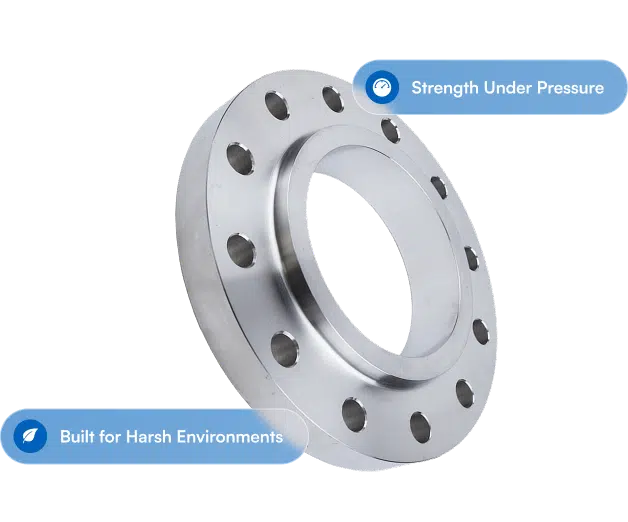
If y'all work in upstream oil and gas, refinin', or any application where pressure ratings push past the 300# class, you've probably come across RTJ flanges. Dey show up on nearly every high-pressure spec sheet, and for good reason. Ring type joint connections give you a metal-to-metal seal that gasket materials alone can't match at extreme pressures and temperatures. Specifyin' the right RTJ flange takes more than just matchin' a size and class. You need the correct ring groove profile, the right gasket style, and the right material pairin' to make the joint work as an optimal seal.
This guide walks through what RTJ flanges are, how dey differ from raised face and flat face connections, when dey're the right call, and what to watch for when you're puttin' together a spec.
What Sets an RTJ Flange Apart
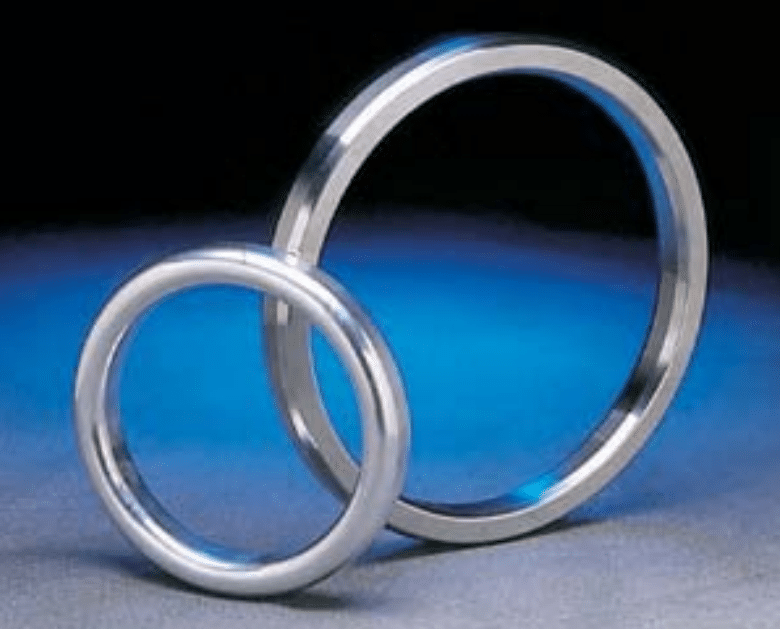
Now, an RTJ (Ring Type Joint) flange uses a machined metal ring gasket seated in a precision-cut groove on the flange face. Unlike raised face flanges that rely on compressed sheet gaskets or spiral wound gaskets, RTJ flanges get their seal through controlled deformation of a soft metal ring against hard groove walls. When the bolts get torqued, the ring gasket yields into the groove surfaces, makin' a tight metal-to-metal seal.
The groove itself is what defines it. Per ASME B16.5, RTJ flanges are manufactured with either R-type or RX-type grooves machined right into the flange face. The groove geometry, depth, and surface finish are tightly controlled 'cause even small deviations will compromise the seal. Dis ain't like a raised face connection where you got some tolerance in the gasket compression. With RTJ, precision matters, friend.
RTJ flanges come in all standard ASME B16.5 sizes (1/2″ through 24″) and pressure classes from 150# through 2500#, though dey become the standard choice startin' at 900# and above. For larger sizes, ASME B16.47 covers RTJ configurations in Series A and Series B flanges. In API 6A wellhead and Christmas tree applications, RTJ connections are pretty much the default, rated up to 20,000 PSI.
RTJ Gasket Types: R, RX, and BX, Sorted Out
Not all ring gaskets are interchangeable, and gettin' dis wrong is one of the most common mistakes in RTJ specifications. There's three main styles defined by ASME B16.20 and API 6A:
R-type gaskets are the standard oval or octagonal cross-section rings used with ASME B16.5 flanges. Octagonal rings seal a little better 'cause dey make line contact with the groove walls rather than the area contact of oval rings. Both seat in the same R-type groove, but octagonal is the preferred choice for new construction.
RX-type gaskets are pressure-energized versions of the R-type. Dey fit into standard R-type grooves but got a modified cross-section that lets internal pressure further energize the seal. The big advantage: RX gaskets are interchangeable with R-type grooves, so you get better performance without changin' flanges.
BX-type gaskets are a completely different design used only with API 6BX flanges. Dey need a dedicated BX groove and ain't interchangeable with R or RX grooves. You'll find these on wellheads, trees, and other API 6A rated equipment at 5,000 PSI and above.
| Gasket Type | Cross-Section | Groove Type | Standard | Typical Application |
| R (Oval) | Oval | R-type | ASME B16.20 | General high-pressure, legacy installations |
| R (Octagonal) | Octagonal | R-type | ASME B16.20 | Preferred for new construction, better sealing |
| RX | Modified octagonal | R-type (interchangeable) | API 6A | Pressure cycling, thermal cycling, wellhead |
| BX | Square/rectangular | BX-type (dedicated) | API 6A / 6BX | Wellheads, trees, 5,000+ PSI rated equipment |

When to Call for RTJ Over Raised Face
The short answer: when pressure, temperature, or safety classification demands it. Here's the more useful breakdown, y'all.
Pressure class 900# and above. ASME B16.5 allows raised face connections at 900# and higher, but most engineerin' specs default to RTJ at dese classes. The metal-to-metal seal handles the higher bolt loads and flange stresses better than gasket-dependent connections. At 1500# and 2500#, RTJ is pretty much universal.
Sour service and NACE MR0175/ISO 15156 applications. When hydrogen sulfide is present, the integrity requirements go up mighty high. RTJ connections with properly specified gasket materials (typically soft iron, low-carbon steel, or nickel alloys dependin' on the environment) are preferred 'cause dey eliminate the risk of gasket blowout under corrosive attack.
High-temperature service above 750F. Spiral wound and sheet gaskets got temperature limitations that metallic ring gaskets don't. For applications in the 750F to 1,100F range (think FCC units, reformers, high-temperature steam), RTJ connections keep their seal integrity where non-metallic gasket elements would break down.
API 6A wellhead and tree equipment. If you're specifyin' anything per API 6A, RTJ (or BX) ain't optional. It's the required connection type. This covers wellheads, Christmas trees, chokes, actuators, and related pressure-containing equipment from 2,000 to 20,000 PSI working pressure.
Critical service per ASME B31.3. For Category M fluid service (lethal substances), many owner specifications require RTJ connections regardless of pressure class. The reasonin' is simple: the metal-to-metal seal gives an extra layer of safety that non-metallic gaskets can't guarantee over the life of the joint.
Specifyin' RTJ Flanges: What to Include
When you're puttin' together a purchase order or material requisition for RTJ flanges, here's what needs to be on the line item so y'all avoid all the back-and-forth:
Size and pressure class. Standard format: 4″ 900# RTJ WN A105. Don't leave out the facin' designation. If somebody writes “4 inch 900 class weld neck” without sayin' RF or RTJ, that's a guaranteed back-and-forth.
Flange type. Weld Neck (WN), Blind (BL), and Slip-On (SO) are all available in RTJ configurations per ASME B16.5. Weld Neck is the most common 'cause the integral hub gives better stress distribution at high pressures.
Material grade. Carbon steel (A105, A350 LF2), stainless (SA-182 F304/F304L, F316/F316L), chrome-moly (F11, F22, F91), and nickel alloys (625, 825) are all available. Match the gasket material compatibility to your service conditions.
Ring gasket number. Every size and class combination has a specific ring number per ASME B16.20. A 4″ 900# RTJ flange uses an R-45 ring gasket. Dis number gotta match between mating flanges, and the gasket is ordered separate.
Applicable standard. ASME B16.5 for NPS 1/2″ through 24″, ASME B16.47 for NPS 26″ through 60″, or API 6A for wellhead equipment. A B16.5 RTJ groove and an API 6A BX groove ain't the same thing.

Common Mistakes Folks Make with RTJ Flanges
A few things that trip folks up, and dey're worth knowin' before you order:
Reusin' ring gaskets is probably the most frequent error. RTJ gaskets are single-use. The controlled deformation that makes the seal means the gasket conforms to the groove surfaces durin' initial makeup. Reinstallin' the same gasket won't give you the same seal. Always use a new ring per ASME PCC-1 guidelines.
Mixin' R-type and BX grooves happens more often than anybody wants to admit, 'specially on projects where both ASME and API equipment are in the same system. An R-type gasket in a BX groove (or vice versa) won't seal. Verify the groove type on the flange markin' before installin' gaskets.
Incorrect bolt torque on RTJ joints is another common problem. 'Cause the gasket is metallic, bolt torque sequences and values are more critical than with soft gaskets. ASME PCC-1 gives detailed torque procedures for flanged joints, and followin' a proper star pattern with multiple passes ain't optional on RTJ connections.
Bottom Line, Plain and Simple
RTJ flanges are the standard for high-pressure, high-temperature, and critical service pipin'. Dey cost more than raised face flanges, and the gaskets are pricier than spiral wounds, but the seal integrity justifies the investment in any application where failure ain't acceptable. If y'all are specifyin' 900# and above, workin' with API 6A equipment, or dealin' with sour service, RTJ is the way to go.
Need RTJ flanges quoted? Texas Flange carries RTJ configurations across all standard sizes, pressure classes, and material grades. Get in touch with our team and we'll have pricing and availability back to you right quick.
Texas Flange & Fitting Supply | 281-484-8325 | texasflange.com