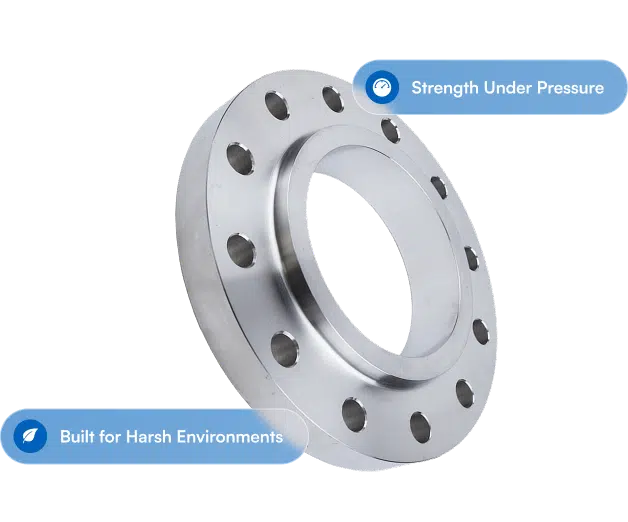
Flanges give y'all structural integrity and a leak-free connection in industries like oil and gas, chemical processin', and power generation, yessir.
But when y'all gotta pick between bolted and welded flanges, reliability is what matters most. Both kinds of connection got good and bad points, so which one's the most reliable, bolted vs. welded flanges?
All about bolted flanges
Bolted flanges (blind, welding neck, socket weld, slip-on, threaded, lap joint, orifice, and expander flanges.) are made to be joined together with bolts and gaskets. The main job of them bolts is to make enough clampin' force for a tight, leak-proof seal. Folks commonly use dese flanges where y'all gotta take 'em apart for maintenance.
Good points of bolted flanges:
- Easy maintenance: Bolted flanges come apart easy, so repairs and replacements are a whole lot more convenient without cuttin' the pipe or messin' up the system.
- Flexibility: Dese flanges let y'all make adjustments, realign, and expand the piping system as needed.
- No welding needed: Since bolted connections don't need welding, y'all dodge the risks that come with heat-affected zones and welding defects.
Not-so-good points of bolted flanges:
- Could leak: Usin' gaskets and lots of fastenin' points makes possible leak paths, 'specially if the bolts ain't tightened right or the gasket wears out over time.
- Needs regular maintenance: On account of thermal expansion, vibration, and pressure changes, bolted flanges need tightenin' and inspectin' every so often.
- Takes up space: Havin' bolts and nuts means y'all need more room for installation and maintenance.
All about welded flanges
Welded flanges (weld neck, slip-on, blind, socket weld, and lap joint) get attached to the pipe for good with a welding process. Dat makes a strong, long-lastin' connection, mighty good for high-pressure and high-temperature work.
Good points of welded flanges:
- Extra strength and integrity: Welding makes a seamless joint dat cuts down on leaks, so it's the favorite for critical systems.
- Less maintenance: Since there ain't no bolts or gaskets, welded flanges need less maintenance as time goes on.
- Better in rough conditions: Welded flanges take high pressures, extreme temperatures, and corrosive environments better than bolted connections do.
Not-so-good points of welded flanges:
- Stays put for good: Once it's welded, y'all can't easily remove or replace dese flanges, so changes or repairs take a heap of work.
- Welding-related defects: Poor welding techniques can bring in defects like porosity, cracks, and weak joints, and dat can hurt reliability.
- Costs more to install: Needin' skilled welders and special equipment pushes up the startin' cost and the installation time.
Reliability comparison: Bolted vs. welded flanges
When y'all are figurin' which connection type is more reliable, Bolted vs. Welded flanges, there's several things to think about, like operatin' conditions, maintenance needs, and the risk of leaks.
- Leak prevention: Welded flanges got the edge on stoppin' leaks since dey get rid of gasket troubles. But with proper bolt tightenin' and good gaskets, bolted flanges can be just as reliable.
- Holdin' up in rough environments: Welded flanges generally do better in extreme conditions because of the seamless design and how dey handle temperature and pressure swings.
- Easy inspection and maintenance: Bolted flanges got a big advantage when it comes to maintenance and repairs. Dey come apart quick, where welded flanges take a heap of work for changes or replacements.
- Cost and installation time: Bolted flanges usually cost less up front and go in quicker, where welded flanges need special welding procedures dat cost more money and time.
Which flange type is more reliable?
How reliable a flange connection is depends on the job and what the system needs. If stoppin' leaks and strength come first, welded flanges give y'all better performance, 'specially in high-pressure environments.
But if flexibility, easy maintenance, and savin' money matter more, bolted flanges are a practical answer, I reckon.
Pickin' the right flange for what y'all need
Both bolted and welded flanges got their place in industrial work. Welded flanges give y'all unmatched strength and durability, and bolted flanges give y'all flexibility and easy maintenance. Which one y'all go with, Bolted vs. Welded flanges, comes down to operatin' conditions, maintenance capabilities, and what it'll cost over the long haul.
If y'all are lookin' for high-quality flanges for your industrial work, Texas Flange been makin' flanges straight from the source since 1986, and we got a full selection of Bolted vs. Welded flanges built for durability and reliability. Have a look at our range of products and find the right fit for your piping system today!
FAQ’s
What's the difference between Bolted and Welded Flanges?
Bolted flanges use bolts to join two parts, givin' y'all a connection dat comes apart and can be adjusted. Welded flanges get attached to pipes for good with welding, givin' y'all a stronger, leak-proof seal.
When should I use Bolted flanges over Welded flanges?
Bolted flanges are mighty good for systems dat need frequent maintenance or takin' apart. Welded flanges are used for high-pressure, high-temperature work where y'all need a permanent, secure connection.