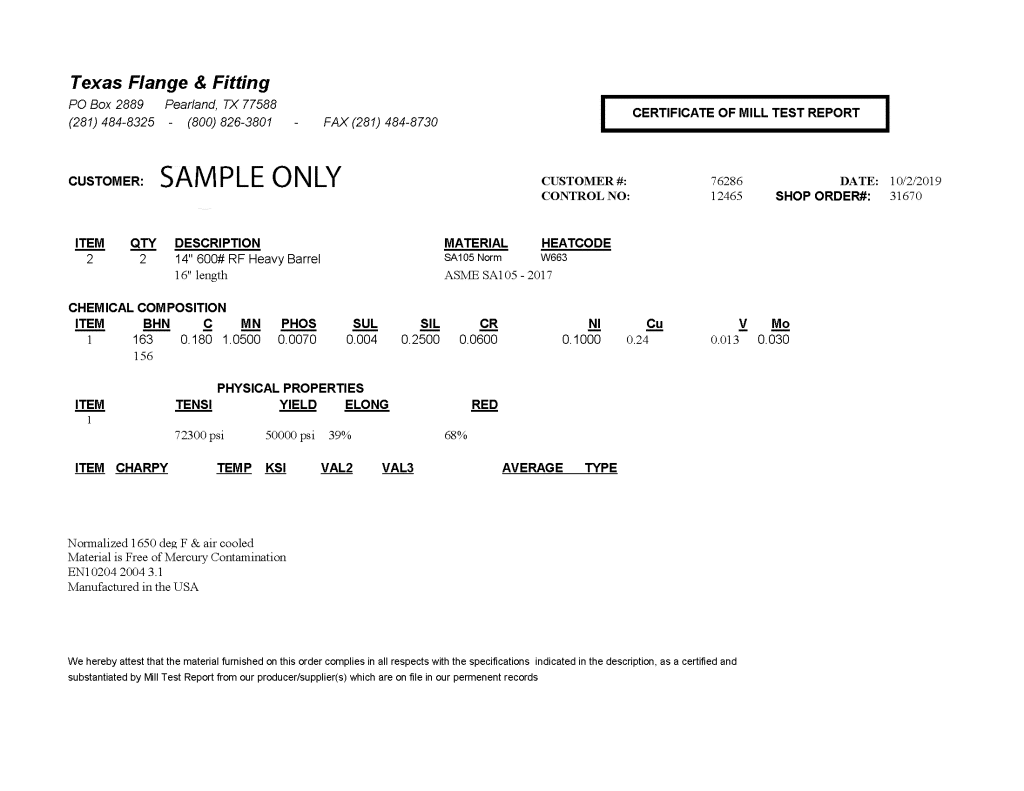
Whether you’re a procurement pro or a foreman out on the job site, y’all have likely heard the phrase “Where are the papers?” more times than you can count. In our line of work, dem “papers” are the Mill Test Report (MTR).
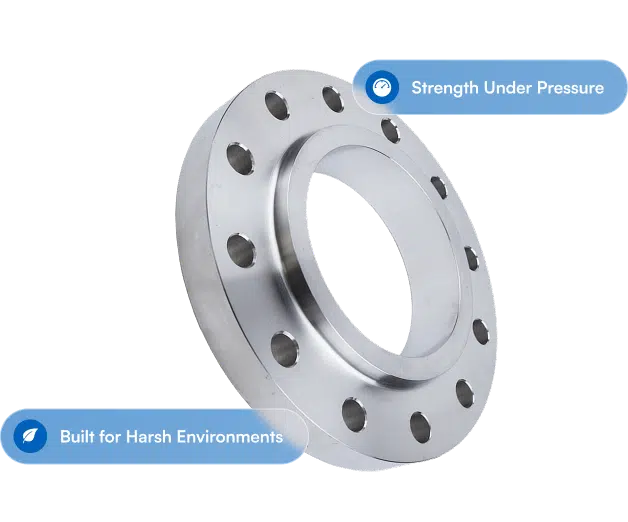
Now, an MTR is basically the birth certificate of a flangeIt tells you where the steel come from, what’s inside it, and exactly how much pressure it can take before it gives up the ghost. When y’all are dealin’ with flange pipe systems haulin’ high-pressure steam or volatile chemicals, “close enough” don’t cut it, no sir. You gotta know the steel in your hand matches the specs on your blueprint.
At Texas Flange, we reckon understandin’ your MTR is just as important as pickin’ the right flangesLet’s break down how to read these papers so your project stays safe, compliant, and on schedule.
Traceability: Tyin’ It to the Heat Number
The single most important word in quality assurance is traceabilityIf you can’t trace a piece of steel back to the furnace it got melted in, it got no business in your pipeline.
The Heat Number
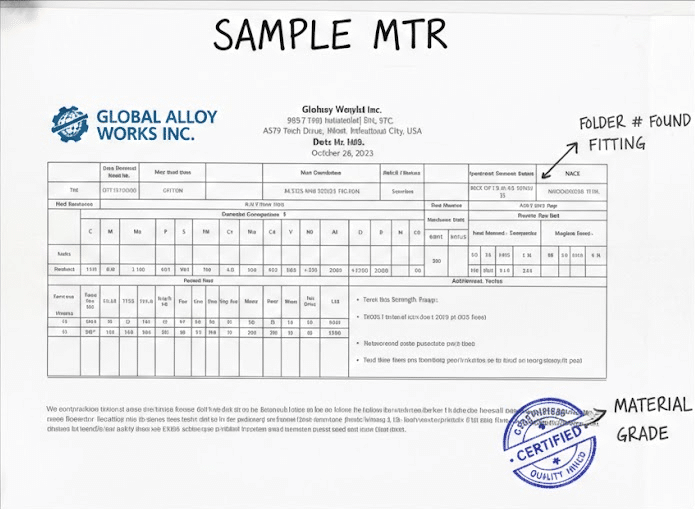
Every MTR is built around a Heat NumberThat’s a one-of-a-kind ID code put on a particular batch of steel while it’s bein’ melted at the mill. When we make a flange, dat heat number gets stamped right into the rim of the metal.
Chain of Custody
Traceability makes a “chain of custody.” It’s a paper trail that proves nobody swapped the material out for somethin’ cheaper and weaker somewhere between the mill and your delivery truck. When your order shows up, the first thing you oughta do is check that the heat number stamped on the flange matches the heat number on the MTR. If they don’t match, the chain’s broke, and your quality assurance just went out the window.

Material Grades and Mechanical Limits
Once you’ve confirmed you got the right paperwork for the right part, it’s time to see what that metal’s really made of. This section of the MTR splits into two main categories: Chemical Requirements and Mechanical Properties.
Chemical Composition
This table lists the percentages of elements like Carbon, Manganese, Phosphorus, Sulfur, and Silicon. For example, if y’all are lookin’ at a standard flange pipe application usin’ A105 carbon steel, the MTR will show the Carbon content is capped (usually at 0.35%) so the part stays weldable and don’t get too brittle on you.
Mechanical Properties
This here’s where we see how the material held up under stress tests. You’ll want to look for three key numbers:
- Yield Strength: The point where the metal starts bendin’ for good.
- Tensile Strength: The most stress the metal can take before it breaks.
- Elongation: A measure of the metal’s ductility (how far it can stretch before it gives out).
Think of these as the “performance stats” for your flanges. If the MTR shows a yield strength lower than what the ASTM standard requires for that grade, that flange ain’t nothin’ but a paperweight, not a pipe component.
Standards and Specs
Readin’ an MTR takes a basic handle on the “alphabet soup” of industrial standards. You don’t gotta memorize the books, but you oughta know which ones are callin’ the shots.
- ASTM (American Society for Testing and Materials): These standards say what the material itself is (e.g., ASTM A105 for carbon steel or A182 for stainless steel).
- ASME (American Society of Mechanical Engineers): These standards set the dimensions and pressure ratings. When you see ASME B16.5, it’s tellin’ you the flange was built to specific size and pressure classes (like 150#, 300#, etc.).
- NACE: If your project’s got “sour service” (high H2S environments), your MTR oughta mention NACE MR0175 compliance, which means the material stands up to sulfide stress crackin’.
The MTR will also spell out the Product AnalysisThe mill does a “Heat Analysis” while the steel’s still molten, but a “Product Analysis” is a test run on the finished forged product to make sure the chemistry stays the same after coolin’ and shapin’.
Why MTRs Matter on Your Texas Flange Order
Y’all might be wonderin’, “Do I really gotta be this picky over a simple Slip-On flange?” The short answer is: Yessir.
The type of flange you pick often decides how critical the MTR gets:
- Weld Neck Flanges: Since these get butt-welded to the pipe, the chemical composition (specifically the Carbon Equivalent) is mighty vital for a safe weld.
- Blind Flanges: These act as the end-cap of a system and take the full force of the pressure. The mechanical strength on the MTR is your only guarantee that cap won’t blow.
- Stainless Steel Flanges: In corrosive environments, the MTR confirms the Chromium and Nickel levels are high enough to keep your system from rustin’ out in six months.
Knowin’ how to read these reports before you order lets you tell our team exactly what you need. If your job site requires “100% Domestic” or “No China/India” material, the MTR is the only document that can legally verify the country of melt and manufacture.
Common Mistakes to Steer Clear Of
Even seasoned pros trip up on MTRs now and again. Here’s the most common “gotchas”:
- Ignorin’ the “Supplementary Requirements”: Some jobs call for Charpy V-Notch (impact) testin’ for cold-weather work. If the MTR don’t plainly list them test results, the flange don’t meet the spec, even if the grade is right.
- Illegible Scans: Sounds simple, but if you can’t read the Heat Number ’cause the scan’s blurry, that document ain’t worth a lick in an audit.
- Acceptin’ “Certified True Copies” without a Signature: An MTR is a legal document. Somebody from quality assurance at the mill or the manufacturer oughta sign it.
- Mismatched Units: Always check if the measurements are in Imperial (PSI) or Metric (MPa). Mixin’ them up can lead to some disastrous math errors durin’ system design.
Wrappin’ Up: Quality You Can Trace
At the end of the day, a Mill Test Report is about peace of mind. It’s the proof that the flanges y’all are installin’ are exactly what you paid for and, more important, exactly what your crew’s safety calls for. By checkin’ them heat numbers, verifyin’ the mechanical limits, and makin’ sure the standards match your specs, you’re protectin’ your project from costly failures and liability.
We know these specs can get complicated. Between the ASME codes and the chemical variances, it’s a whole lot to juggle. That’s why we’re here.
Need a Quote With Full Traceability? Holler at Us.
If y’all are lookin’ for high-quality flanges and need a partner who can help you get through the paperwork, we’ve got you covered. Every part we ship is backed by the technical know-how and documentation you need to get the job done right.
Holler at Texas Flange today for a quote and let us help you get your next project done with confidence. Whether it’s a standard order or a custom spec, we’ll make sure dem “papers” are right where they need to be.