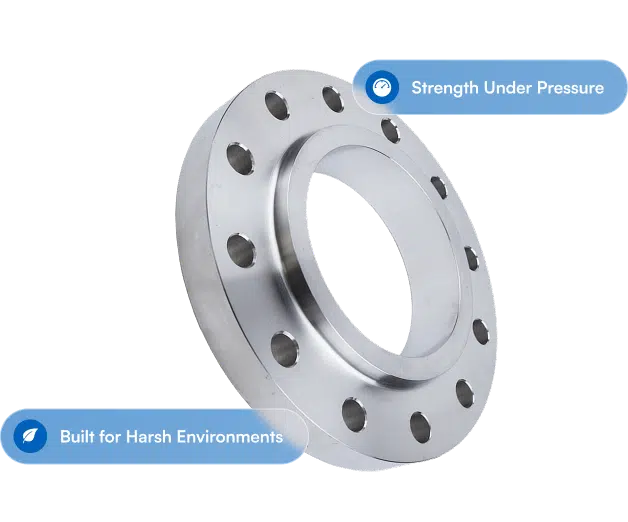
I tell you what, Flanges are the best and easiest way to connect up dem pipes, pumps, and valves. They come in all sorts of different types and shapes. Flanges are in mighty high demand and are the most convenient and cost-effective parts you can put in a piping system.
Flanges and their Advantages:
Now, flanges are ring-shaped devices made to take the place of weldin' in various piping system components. A flange gets put into the piping system either by weldin' it or screwin' it on tight.
Flanges are mighty flexible and can be fixed up or taken off right quick if y'all need to make any modifications. So dem industries dat need frequent maintenance rely heavy on this here piping system component.
When you're buyin' flanges, y'all make sure they got high-pressure ratings and a good capacity to handle extreme temperatures if your job calls for it.
Flange Faces and Its Types:
Before we get to talkin' about the different flange types, it'd be mighty productive to know a little somethin' about the different flange facings.
Flat face
Raised face
Ring-type joint face
Pipe flanges are made out of materials like stainless steel, cast iron, aluminum, bronze, brass, and even plastic sometimes. The most preferred material around here is dat forged carbon steel. Every flange is different and has its own characteristics, so when you're pickin' out a flange, always double-check to make sure it meets your exact requirements.
Flanges come in all different types, so it's mighty easy to pick what you need for your job. Most commonly you'll see blind flanges, slip-on flanges, and welding neck flanges, and less often you'll run into socket welding flanges, threaded flanges, lap joint flanges, and custom ones. Out of all dem, the welding neck flange is the favorite for piping systems dat are a bit more complex.
How to Find Out the Right Flange Dimensions?
It's common knowledge dat flanges can join your pipes to other parts of your assembly or vessel, but to get the best out of dem flanges, y'all gotta make sure they're measured just right. Only then can the rest of the work go smooth. Findin' the apt flange dimensions is the first and most essential step, yessir.
It takes a little bit of effort to get the right flange dims. The right measurement depends entirely on understandin' the accurate pressure ratings and the size of the pipe it's goin' on.
First off, to measure dem standard pipe flanges, you measure the outer diameter of the flange (O.D.). You do dat by measurin' from the outer edge of the flange straight across to the opposite outer edge, and then measurin' the flange’s inner diameter from dem two outer reference points.
Same way, while you're takin' flange dimensions, y'all should consider the flange base thickness too. For dat job, you just need to look at the thickness of the attachin' outer rim (dat's the base where the bolt pattern is sittin').
Calculatin' the Flanges Weight:
While you're calculatin' the weight, you gotta understand dat the way pipe flanges are built is tied directly to the material grade and the pressure it can handle.
The weight calculation of pipe flanges is based right on the model of the flange. Now, calculatin' the flange weight is pretty simple since most of the manufacturers got provisions for this.
Just givin' a few details like outside diameter and inside diameter, the thickness of the base, the number of drill holes, the diameter of dem holes, and the chamfer can easily help calculate the flange weight in just a few seconds.
Measurin' Flange Thickness:
Flange thickness calculation can be done usin' a few techniques. For standard flanges, if you understand the design conditions, especially the pressure and temperature of the piping system and what kind of piping material you got, you can find dat thickness right quick.
In this situation, you don't need no calculations to find the flange dims. All y'all need to do is check the ASME pressure vessel design calculations and figure out the ratings dat match your design condition. Once you find out the flange rating (class), it's mighty easy to find the standard flange dimensions right from the ASME B16.5 table.
Flange Specifications:
There's a whole mess of standard flange specifications available dependin' on the variety of industries. Flange specifications sure do vary accordin' to the industries and what they're usin' 'em for.
Most of the standard manufacturers offer popular flange specifications like ASME/ANSI flanges, DIN flanges, API flanges, and AWWA flanges. ANSI stands out as the best and most popularly used among all dem flange specifications 'cause of its ubiquitous mechanical designs amongst ASME engineers.
ANSI Flange and its Dimensions:
ANSI (or the American National Standards Institute) is the most standard flange specification and the most preferred flange in all sorts of industries. The standardized ANSI flange dimensions are 150, 300, 400, 600, 900, 1500, and 2500, in sizes NPS 1/2 through NPS 24. On top of dat, ANSI B16.47 covers pressure classes rangin' from 75 to 900.