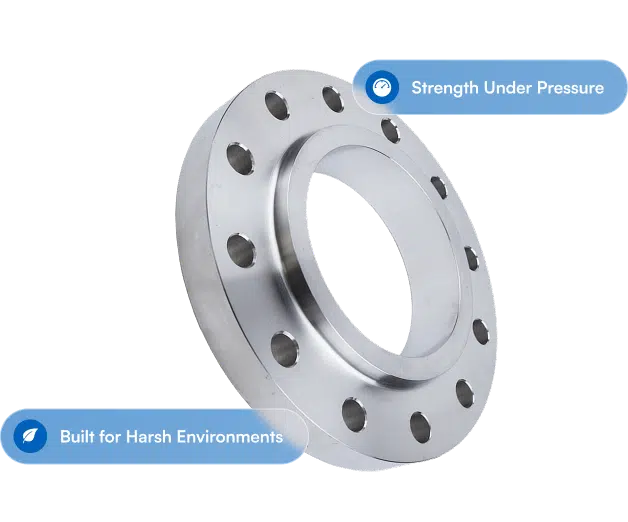
A flange size chart isn’t complicated, but if y'all never worked with one before, all dem columns and footnotes can get mighty confusin' when you're just lookin' for a quick reference on one item. Pipe size, outside diameter, bolt circle, number of bolts, bolt diameter, raised face diameter, thickness… it's a lot to keep track of, but y'all need all of it to call out the right part.
We been helpin' engineers, procurement managers, and contractors source the right flanges since 1986. In all dat time, we've answered a whole mess of questions about how to read flange dimension tables, so here's the straightforward breakdown.
What in the World Is a Flange Size Chart?
A flange size chart, more formally called a flange dimension table, is a reference document dat lists the standardized physical dimensions for flanges across different pipe sizes and pressure classes. Dese dimensions are governed by ASME and ANSI standards, mainly ASME B16.5 for pipe sizes ½” through 24″, and ASME B16.47 Series A and B for bigger diameter flanges from 26″ through 60″ and beyond.
The whole point of dese standardized dimensions is interchangeability. When y'all order a 6″ class 150# weld neck flange from any compliant manufacturer anywhere in the world, the bolt circle, bolt hole diameter, outside diameter, and raised face dimensions oughta be identical. Dat's what makes ASME-standard flanges so practical for industrial piping systems, I reckon.
Key Dimensions on a Flange Size Chart, friend
Before y'all can read a flange dimension table, you gotta understand what each column stands for. Here are the critical dimensions:
Nominal Pipe Size (NPS)
NPS is the standardized name for pipe size. It ain't a real measurement; it's a nominal reference number. Though it'd make sense to think so if y'all are a first-timer, a 2″ NPS pipe don't have a 2″ outside diameter. The OD of a 2″ pipe is actually 2.375″. Once y'all understand dat NPS is a reference number and not a true dimension, a lot of the first confusion clears right up.
Outside Diameter (OD) of the Flange
Dis is the total outer diameter of the flange itself, not the pipe. Folks mix dis OD dimension up with the NPS all the time, and some will call out a flange by describin' the OD first. Flange OD goes up with both pipe size and pressure class. A higher pressure class flange has a bigger OD (and more material mass) than a lower class flange at the same NPS.
Bolt Circle Diameter (BCD)
The bolt circle is the diameter of the imaginary circle dat passes through the center of all the bolt holes. Dis is a critical dimension for matin' flanges: both flanges in a pair gotta have the same bolt circle for the bolts to line up. Mismatched bolt circles mean the flanges won’t connect, no matter how close the ODs are, so it's important dat dese line up.
Number of Bolts and Bolt Hole Diameter
The number of bolt holes is always a multiple of four, 4, 8, 12, 16, 20, 'cause flanges gotta be assembled in 90° orientations and still line up. Bolt hole diameter is a little bigger than the bolt so it'll go in. Both the bolt count and hole size go up with pressure class and flange size.
Flange Thickness
Thickness is usually the measurement of the base of the flange where the bolt pattern sits, and it goes up with pressure class. A Class 600# flange is a whole lot thicker than a Class 150# flange at the same NPS 'cause it's got to stand up to higher internal pressure. Thickness matters too when y'all are figurin' clearance in tight installations. Sometimes thickness gets used to describe the measurement of the flange from the top of the hub to the bottom of the face, and in dat case y'all want to use the terms “overall length” or “full length through the hub” to describe dese flanges.
Raised Face (RF) Diameter
Most ASME B16.5 flanges have a raised face, a slightly raised circular seatin' surface where the gasket sits. The RF diameter is smaller than the flange OD and is the surface dat actually touches and squeezes the gasket. Knowin' the RF diameter is important for gasket selection, and knowin' the pressure class tells y'all the thickness of said raised face.

Sample ASME B16.5 Class 150# Flange Dimensions
Here's a condensed reference table for ASME B16.5 Class 150# raised face flanges across common pipe sizes:
| NPS | Flange OD | Thickness | # Bolts | Bolt Dia. | RF thickness |
|---|---|---|---|---|---|
| ½” | 3.50″ | 0.38″ | 4 | 0.62″ | 1/16″ |
| 1″ | 4.25″ | 0.50″ | 4 | 0.62″ | 1/16″ |
| 2″ | 6.00″ | 0.69″ | 4 | 0.75″ | 1/16″ |
| 4″ | 9.00″ | 0.88″ | 8 | 0.75″ | 1/16″ |
| 6″ | 11.00″ | 0.94″ | 8 | 0.88″ | 1/16″ |
| 8″ | 13.50″ | 1.06″ | 8 | 0.88″ | 1/16″ |
| 10″ | 16.00″ | 1.12″ | 12 | 1.00″ | 1/16″ |
| 12″ | 19.00″ | 1.19″ | 12 | 1.00″ | 1/16″ |
All dimensions per ASME B16.5. Dimensions in inches. Bolt circle diameter (BCD) varies, so refer to the full ASME B16.5 tables for complete data. See our Class 150 dimension tables for the full set.
For a complete flange bolt chart with all the pressure classes and pipe sizes, take a look at our flange bolt circle and bolt count chart.
How Pressure Class Changes the Flange Dimensions
Dis is where engineers and procurement folks sometimes get tripped up. Each pressure class, 150#, 300#, 600#, 900#, 1500#, 2500#, has its own dimension table. Flanges at the same NPS but different pressure classes are NOT interchangeable, so check ever' value.
A 4″ Class 300# flange has a bigger OD, a bigger bolt circle, more bolt holes, and more thickness than a 4″ Class 150# flange. Dey won’t bolt together, and even if y'all could force 'em together, the matin' surfaces wouldn’t line up right no how.
Always check the pressure class before y'all order. Out in the field, dis is one of the most common ways flanges end up mismatched – somebody orders a replacement flange by size alone without confirmin' the pressure class.
ASME B16.5 vs. ASME B16.47: Which Standard Y'all Need?
The standard y'all're workin' from depends on the pipe size:
- ASME B16.5 covers flanges from ½” NPS through 24″ NPS in pressure classes 150# through 2500#
- ASME B16.47 covers large diameter flanges from 26″ NPS through 60″ NPS, in two series: Series A (MSS SP-44) and Series B (API 605)
For the vast majority of piping work, ASME B16.5 is the governin' standard. ASME B16.47 comes into play for large-diameter pipeline and vessel jobs, think major transmission pipelines, big ol' storage vessels, and similar infrastructure.
Practical Tips for Usin' Flange Dimension Tables
- Always confirm NPS, pressure class, and flange type before y'all pull dimensions. A weld neck and a slip-on flange at the same NPS and class share the same bolt pattern but got different hub dimensions. Weld neck bores follow the pipe schedule and not the flange, so check the weld neck flange bore dimensions.
- Use the bolt circle diameter to check dat mating flanges match – dis is the most field-critical dimension to check first, along with the OD stampin'.
- When y'all order replacement flanges, measure the existin' flange OD and bolt circle, then cross-reference to the dimension tables to confirm NPS and class. Don’t rely on markings alone 'cause dey can be worn or misread, but check both anyway
- For custom or non-standard sizes, the dimensions won’t be in the standard tables. Dat’s where workin' with a supplier who can do custom fabrication matters, like we'd offer to your provided prints.
Need Flanges in the Right Size and Class? We Got Y'all.
Texas Flange carries ASME B16.5 and B16.47 flanges in sizes from ½” through 60″+ across all standard pressure classes, in over 50 material grades. Whether y'all are workin' from a dimension table or need help confirmin' the right spec for your application, we can help, yessir.
Holler at us for a quote and we'll get y'all the right flanges, the right size, the right class, ready to ship and install for your project.