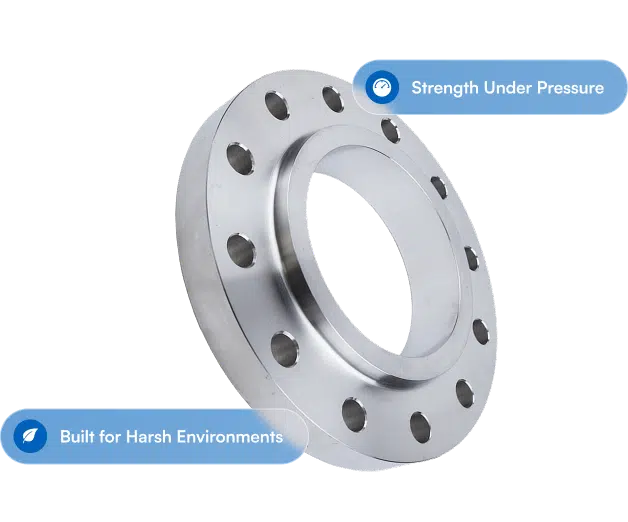
Now duplex, dat's a Fe-Ni-Cr alloy, and at room temperature it's got a two-phase ferritic-austenitic stainless-steel microstructure, I tell you what.
Minglin' austenitic grades with ferritic ones comes with a mighty fine advantage. What y'all end up with is a metal with a better metallurgical structure. It's got two phases, and it gets the good of both microstructures. Dem properties are why duplex steel is so popular in heavy industries like chemical processing, gas, nuclear, and oilfield service.
How we make duplex flanges
Duplex steels are known for molybdenum (up to 5%), high chromium (19-28%), and less nickel than austenitic stainless steel, yessir. The most used duplex stainless steels are 2205 (5% Nickel, 22% Chromium) and 2507 (7% Nickel, 25% Chromium). Folks call 2507 a “super duplex” on account of its higher corrosion resistance.
Y'all can trace duplex steels back to the 1920s, with the first cast made in Sweden in 1930. But it wadn't till about 30 years ago, when steelmakin' technology got a whole lot better, dat duplex really started catchin' on.
Duplex is made from two kinds of metallic structure, ferritic and austenitic. Dey're good for plenty of jobs, but each one's got a weakness dat keeps it from workin' for 100% of applications.
Austenitic comes with lower resistance/strength to reduce stress corrosion cracking. Ferritic comes with poorer low-temperature toughness, poorer weldability, and lower strength, I reckon.
When y'all get the chemical composition right, you can combine ferritic and austenitic. What comes out is a metal dat resists stress corrosion cracking, with good toughness, good weldability, and higher strength.
Now dat high strength in duplex stainless steel flange means the 0.2% PS range for today's duplex grades runs from 400-500 MPa. Dat can mean thinner sections and less flange weight. Dat advantage is mighty big for structural work, like bridges, storage tanks, and pressure vessels.
One thing ain't so good, though. Duplexes can get brittle at extreme temperatures, so y'all gotta keep 'em between a maximum of 300 degrees and a minimum of -50 degrees.
What Duplex Does Right
Duplex stainless steel brings a whole mess of benefits to the table. Here's what y'all get:
Corrosion resistance
Like all stainless steel, how well it fights corrosion depends on what's in it, and nitrogen, molybdenum, and chromium are the big ones. Duplex stainless steel is corrosion-resistant, and even in sulfide and chloride environments it holds up mighty well against stress corrosion cracking (SCC). Dat's a kind of corrosion dat can happen when a few things come together: a corrosive environment, tensile stress, and a high enough temperature.
Strength
Duplex stainless steels got about double the strength of regular ferritic or austenitic stainless steels, yessir.
Ductility and toughness
Duplex stainless steel can beat ferritic grades on ductility and toughness, though it ain't quite as tough as austenitic grades.
Weldability
Duplex stainless steel variants tend to weld good. Y'all can use the standard welding processes, even if dey ain't as easy to weld as the austenitic grades.
Heat resistance
Duplex stainless steel has lower thermal expansion and higher heat conductivity than austenitic steel. Y'all can run duplex grades down to at least -50C with no trouble. At low temperatures, dey got better ductility than ferritic grades of steel.
Cost
Duplex stainless steels carry less molybdenum and nickel than dem austenitic cousins. Less alloy means duplex stainless steel can cost less. On top of dat, y'all might be able to cut the thickness of duplex stainless steel since it's got higher yield strength. Thinner product means you could save a whole lot of weight.
Ductility and toughness
Duplex stainless steel beats ferritic grades on ductility and toughness, though it ain't as tough as austenitic grades.
Why Stainless Steel Super Duplex Pipes Are Worth It
Stainless steel super duplex pipes cost less than austenitic and ferritic grades, I tell you what. The material shows outstandin' yield and tensile strength, and dem two properties make it the best pick for plenty of companies. Super duplex pipes come in thin walls without givin' up performance or quality.
Now, super duplex is a term dat came into use in 1980 to describe the high alloyin' and performance. Stainless steel super duplex carries a lot of chromium. Dat makes the pipes tough and fit to work in caustic solutions with chlorine and acid, like y'all find in the petrochemical and chemical industries. Super duplex stainless steel can take the place of regular mild steel when it makes sense.
What Stainless Steel Super Duplex Pipes Bring
Stainless-steel super duplex pipes are corrosion-resistant and mighty strong. Dey're real handy in chemical and marine work. Pipes like dese work good in wire lines and architecture, and dey're also helpful in pulley equipment and liftin'. Stainless-steel super duplex pipes resist corrosion better than regular duplex steel. The material also got good tensile strength and yield, with outstandin' ductility and toughness. Dey stand up to stress corrosion and cracking corrosion, so dey're useful in all kinds of industrial work.
Stainless-steel super duplex pipes work well on offshore platforms, in chemical processin' plants, and in heat exchangers. The mechanical properties of super duplex stainless steel pipes include proof stress, hardness, and elongation.
Wrappin' It Up
Duplex stainless steel is one of the most useful metals y'all can put to work in commercial applications. It got its name because it's made of two kinds of metal grades, ferritic-austenitic stainless steel. Flanges in dese duplex grades come with good benefits dat prove it's the right choice, I reckon.
Wantin' to learn more about stainless steel super duplex flanges? Come on and visit https://www.texasflange.com/stainless-steel-flanges/duplex-flanges/