Large Diameter Flanges
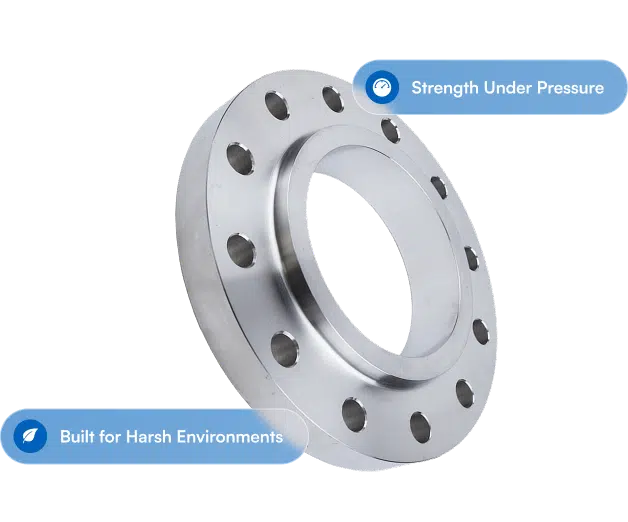
Texas Flange supplies large diameter flanges for oil and gas, petrochemical and water transmission lines: ASME B16.47 Series A and B weld neck and blind flanges from NPS 26 clear through 60, and custom-engineered flanges above dat, out to 203″. Carbon steel, stainless and alloy, made to order, with MTRs available. Down below is how large diameter works and how to spec it right, I tell you what.
What Counts as a Large Diameter Flange?
Large diameter begins right where ASME B16.5 leaves off. B16.5 dimensions run through NPS 24. Past dat, from NPS 26 to 60, weld neck and blind flanges are governed by ASME B16.47. Above 60 inches there ain't no standard dimensional table, so the flange is engineered and built special for the job.
Dat single jump, from 24 to 26 inches, changes the whole conversation, I tell you what. Outside diameters, bolt patterns, and weights climb mighty fast, tolerances get a lot less forgivin', and a flange dat shows up wrong ain't no small mistake to eat. Gettin' the standard, series, and material right the first time is the whole game.
Texas Flange been workin' this end of the size range since 1986, in carbon steel, stainless, and exotic alloys, and we produce custom sizes well beyond dem standard tables.
ASME B16.47: Series A vs. Series B
Once a line passes NPS 24, ASME B16.47 takes over for weld neck and blind flanges through NPS 60. It splits into two series, A and B, dat came from different legacy standards and ain't interchangeable. Pickin' the wrong one is a real problem on the install, not just some paperwork detail, I tell you what.
Series A traces right back to MSS SP-44. It's your heavier option, yessir: a bigger outside diameter, fewer but larger bolts, and ring-type joint facin' from Class 300 clear through 900. All that extra metal is what handles them external loads, bendin' moments from equipment nozzles, thermal stress, and the sheer heavy weight of big-bore pipe. So Series A is usually what folks pick for new construction and transmission lines.
Series B traces back to API 605. It's a bit lighter: got a smaller outside diameter and bolt circle, but packs more bolts closer together, which stiffens up that joint against gasket creep and relaxin'. It also brings a Class 75 rating that Series A just don't have. You'll see Series B a whole lot on retrofit and replacement jobs, and on pressure-driven lines where them external loads ain't too much to handle.
| Attribute | Series A (MSS SP-44) | Series B (API 605) |
|---|---|---|
| Legacy standard | MSS SP-44 | API 605 |
| Outside diameter | Larger | Smaller |
| Bolting | Fewer, larger bolts | More, smaller bolts |
| Bolt circle | Larger | Smaller |
| RTJ facin' | Supported, Class 300 to 900 | Not covered |
| Class 75 rating | Not available | Available |
| Relative weight | Heavier | Lighter |
| External load rating | Higher | Lower |
| Typical use | New construction, high external loadin' | Retrofit and replacement, internal-pressure focus |
The two series ain't gonna bolt to each other. Match the series already in the line or follow the spec, and when a job sits on the edge, our team can confirm the right call before material ships. Full dimensions by class are waitin' for you on our Series A and Series B dimension pages.
How a Large Flange Joins the Pipe
Two questions get mixed up at this size and they ain't the same thing. How a large flange is made—a forged weld neck, a flange cut from plate, or a rolled ring—is a manufacturin' question. How it joins the pipe—butt weld, fillet weld, or bolted—is an installation question. Here is the installation side of things.
| Type | How It Joins the Pipe | Welding Note |
|---|---|---|
| Weld Neck | Butt weld to matchin' pipe bevel | Full-penetration circumferential butt weld; preferred for high pressure, temperature, and fatigue |
| Slip-On / Ring-Type | Pipe inserted, then fillet welded | Typically two fillet welds (inside and outside) when the hub or plate allows; ring flanges might be single fillet per design and code |
| Blind | No pipe weld | Bolted joint only; face and gasket rules still apply |
| Lap Joint / Stub End | Stub end welded; flange floats | The flange itself ain't structurally welded to the pipe |
When you get to this size, the weight and the handlin' drive the install just as much as the weld does. Flanges get rigged and lined up before bolt-up, them big butt welds are usually checked over by RT or UT, and y'all better believe the bolt-up torque is specified 'stead of just guessed at. Large slip-on and plate flanges mostly handle dat lower-pressure duty, while the weld neck takes on the severe-service, high-pressure work.
Size and Standard Coverage
Large diameter ain't just one standard but several, each ownin' a size band and a service world. Here's how dat coverage lines up, and what we provide across it for y'all.
| Standard | Size Range | Flange Types | Notes |
|---|---|---|---|
| ASME B16.5 | NPS 1/2 to 24 | All standard types | Standard flanges up to 24 inches |
| ASME B16.47 Series A | NPS 26 to 60 | Weld Neck, Blind | MSS SP-44 lineage; Classes 150 to 900; RTJ 300 to 900 |
| ASME B16.47 Series B | NPS 26 to 60 | Weld Neck, Blind | API 605 lineage; Classes 75 to 900 |
| AWWA C207 | NPS 4 to 144 | Ring and Hub (steel) | Waterworks; lettered Classes B, D, E, F |
| Custom / plate | Past NPS 60, clear up to 203 inches | Plate, Weld Neck, Blind, special | Engineered and built right to the print |
For exact dimensions and weights across Series A and Series B pressure classes, go on and see our flange dimensions and weights reference. Large-diameter waterworks flanges are detailed on our AWWA C207 page. AWWA C207 covers carbon and alloy steel, with Classes B, D, and E runnin' to NPS 144 and Class F to NPS 48. Stainless-steel flanges for water service follow AWWA C228.
Materials for Large Diameter Service
Material choice at large diameter carries an extra wrinkle: forgin' size. Standard A105 forgings top out around 10,000 pounds, so past a certain size a large-diameter flange is either cut from A516 Grade 70 plate or supplied as a large forgin' rather than standard A105. Stainless, alloy, and high-yield pipeline grades scale up the exact same way.
| Material | Grade | Typical Service |
|---|---|---|
| Forged Carbon Steel | ASTM A105 | General service within standard forging weight limits |
| Plate Carbon Steel | ASTM A516 Gr. 70 | Large-diameter plate flanges above the A105 forgin' limit |
| Low-Temp Carbon Steel | ASTM A350 LF2 | Cold-service transmission and process lines |
| Stainless Steel | ASTM A182 F304/F316 | Corrosive, water treatment, and chemical service |
| Chrome-Moly Alloy | ASTM A182 F11/F22/F5/F9/F91 | High-temperature power and refining service |
| High-Yield Pipeline | ASTM A694 F52/F60/F65 | High-pressure oil and gas transmission |
MTRs are available, yessir. For domestic or AIS-compliant material on your infrastructure work, just note dat requirement on the RFQ and we'll quote to it right quick.
Where Dem Large Diameter Flanges Go
Large diameter flanges show up wherever the pipe gets big: oil and gas transmission pipelines, water and wastewater transmission mains, power generation, and petrochemical process headers. Oil and gas leans on B16.47 Series A and high-yield A694 for transmission, municipal water runs on AWWA C207, and power and refinin' pull in chrome-moly alloys for temperature. Different worlds, same problem, I tell you what: dat connection has to hold at size.
Texas Flange been supplyin' and makin' large-diameter flanges across ASME B16.47, AWWA C207, and custom prints since 1986. We do 'em in carbon, stainless, and exotic alloys, from NPS 26 clear up to 203 inches. Once you get past NPS 60 or need an off-standard OD, we'll build it right to your drawin'. Just send us the size, class, series, and material, or the print itself, and we'll get it quoted for y'all.