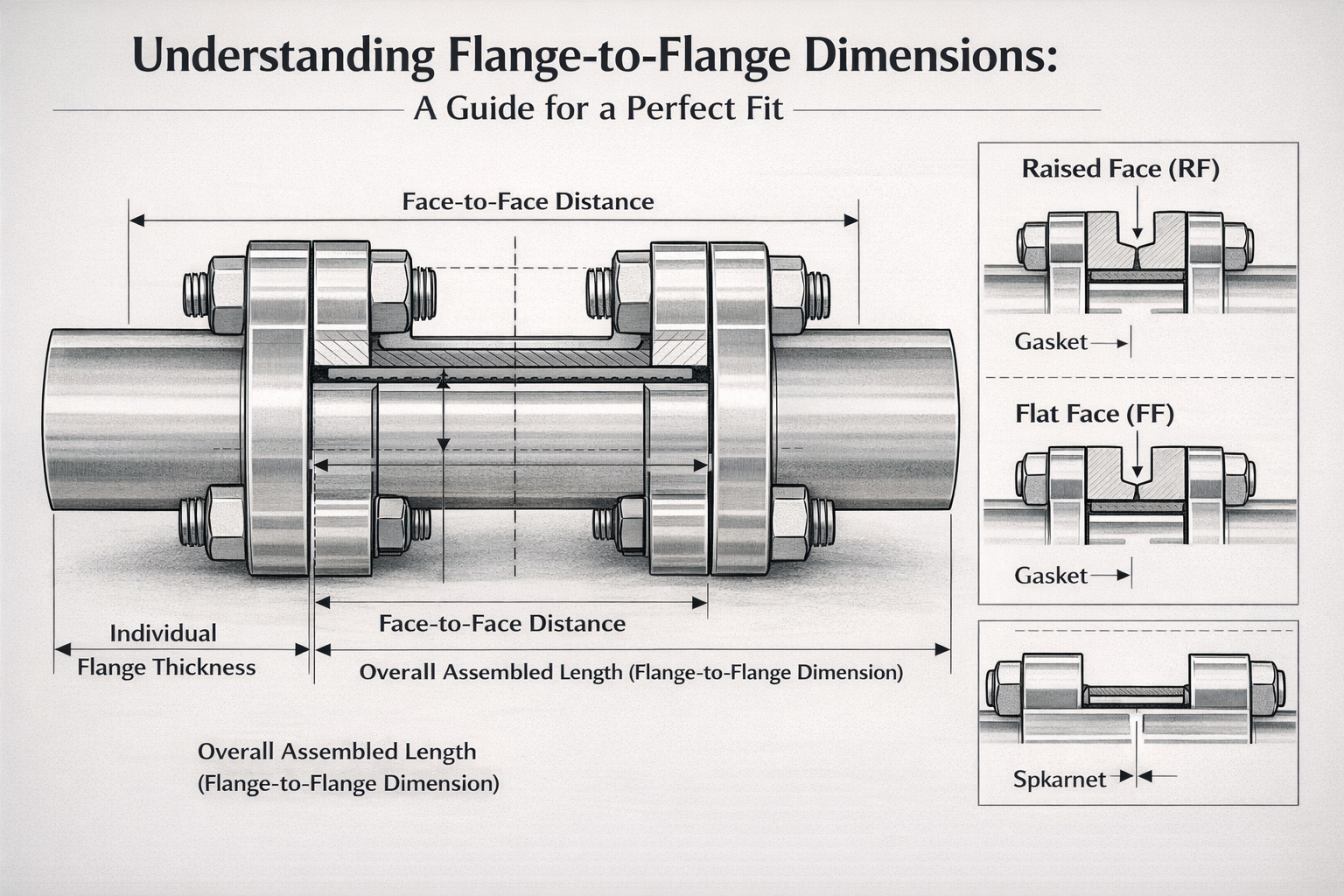
In industrial piping, a flanged connection is only as good as its fit. "Flange-to-flange dimensions" don't refer to one measurement, but to the set of standardized dimensions that ensure two separate flanges can bolt together properly to form a sealed, pressure-tight joint.
Getting these dimensions wrong means bolts won't align, gaskets won't seal, and the connection will fail. This guide explains the critical dimensions, the standards that govern them, and how to ensure compatibility for your project.
The Core Dimensions for Connection
For two flanges to mate, several key dimensions must match exactly. These are defined by published standards like ASME B16.5 for common sizes (NPS 1/2″ to 24″) and ASME B16.47 for larger diameters.
| Dimension | What It Is | Why It Must Match |
|---|---|---|
| Nominal Pipe Size (NPS) | The nominal size of the pipe the flange is designed for (e.g., NPS 4″, NPS 12″). | Ensures flanges are designed for the same pipeline size. |
| Pressure Class | The pressure-temperature rating (150, 300, 600, etc.). | Determines thickness, bolt size, and all other critical dimensions. A Class 150 cannot bolt to a Class 300. |
| Bolt Circle Diameter (BCD) | Diameter of the circle through the centers of all bolt holes. | The single most important dimension for fit-up. Differing BCDs mean bolt holes will not align. |
| Number of Bolt Holes | Total count of bolt holes. | Must be identical for all flanges in the connection. |
| Bolt Hole Diameter | The diameter of the bolt holes. | Must accommodate the correct bolt size with standard clearance (typically 1/8 inch larger than bolt diameter). |
How Dimensions Change: Pressure Class and Size
Flange dimensions are not universal for a given pipe size — they increase with Pressure Class to handle higher forces. The table below illustrates this for NPS 6″:
| Pressure Class | Flange OD | Bolt Circle Diameter | Number of Bolts |
|---|---|---|---|
| Class 150 | 11.00 inches | 9.50 inches | 8 |
| Class 300 | 12.50 inches | 10.62 inches | 12 |
| Class 600 | 14.00 inches | 12.50 inches | 12 |
The Standards Landscape: ANSI/ASME vs. Others
The most common standard in the United States is ASME B16.5 (historically called ANSI B16.5), using imperial measurements in inches. Flanges made to other international standards have completely different dimensions and are generally not interchangeable. For instance, a PN16 flange (ISO standard) will not bolt to an ANSI Class 150 flange, even for the same nominal pipe size.
When sourcing flanges, always specify the complete standard (e.g., ASME B16.5), the NPS, and the Pressure Class to ensure compatible flange-to-flange dimensions.
Frequently Asked Questions
Q: How do I measure an existing flange to identify it?
A: Measure three things: 1) the Outside Diameter (OD), 2) the Bolt Circle Diameter (BCD) — measure from the center of one bolt hole to the center of the hole directly across from it — and 3) the number and size of the bolt holes. Compare these to published ASME B16.5 dimension tables to find the matching NPS and Pressure Class.
Q: Are the dimensions the same for all flange types (Weld Neck, Slip-On, Blind, etc.)?
A: Yes, for the connecting dimensions. OD, BCD, bolt hole count, and bolt hole diameter are standardized within a given NPS and Pressure Class for all flange types covered by ASME B16.5. This ensures a Blind flange can seal against a Weld Neck flange of the same specification.
Q: What is the most common mistake when ordering flanges?
A: Mixing Pressure Classes. Assuming a "6-inch flange" is enough information leads to failure. Always specify both the Nominal Pipe Size (NPS) and the Pressure Class (e.g., "NPS 6, Class 300").
Q: What if my old flange doesn't match any standard table?
A: This happens with custom, specialty, or very old equipment. In these cases, take all critical dimensions (OD, BCD, thickness, bore) and have a flange custom-manufactured to match. This is a common service from specialized manufacturers.